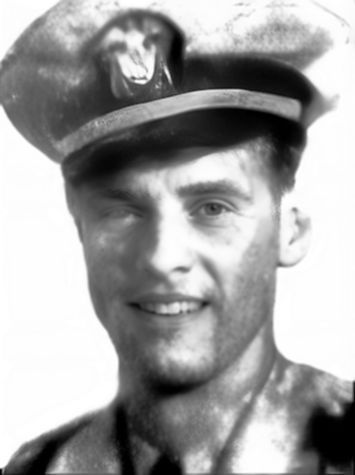
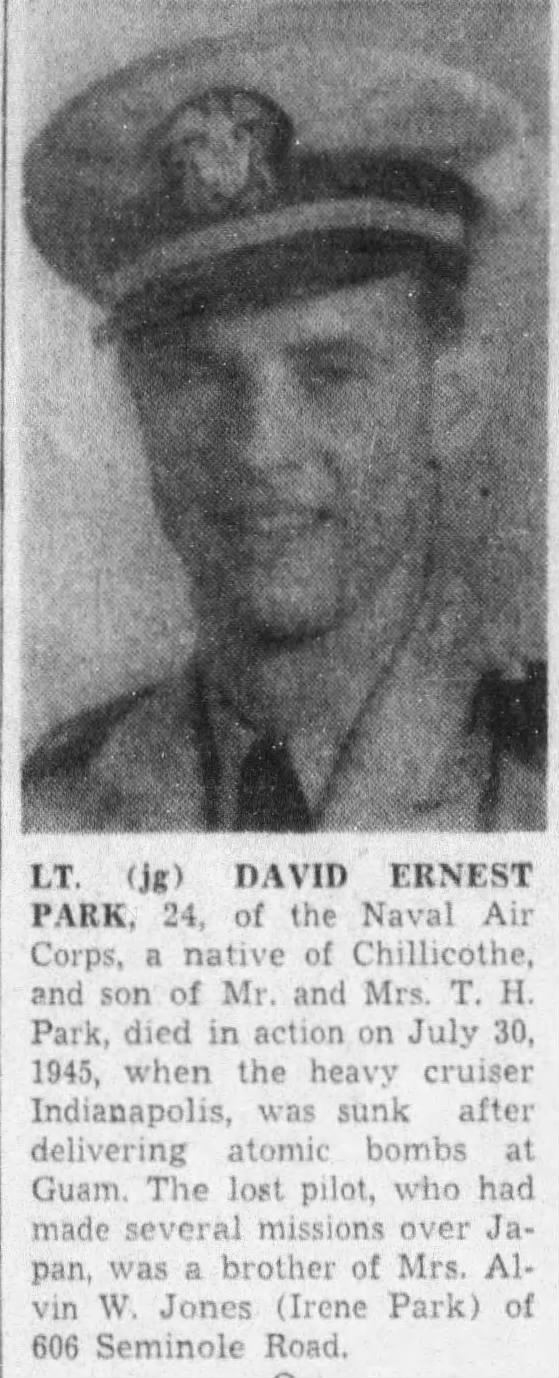
David was born March 14, 1921, in Ross, OH., to Timothy H. Park and Chloe McClannahan. After their marriage, his parents lived in Chillicothe, OH until 1928 when they moved the family to East Los Angeles, CA.
David had a twin sister, Esther C., and sisters Irene and Vernajean and one brother, Wayne Park.
Just blocks from his home, David graduated from Garfield High School with the Summer Class of 1939. While at Garfield, he participated in Gym Club, Dance Orchestra, Senior Orchestra and played the bass in the Football Band.
The 1940 census shows David living in the home of his parents. He was 19 yo, had completed high school and was working for a tire and rubber company.(1)
David enlisted in the USNR on Nov 8, 1940, Los Angeles, CA. He was received at Section Base, San Pedro, CA that same day as a F3c (Fireman 3rd class).
The exact date of his next advancement is not known, but he appears on the muster roll for Sept 20, 1941 as a F2c. He quickly advanced to F1c on Dec 1, 1941.
The base at San Pedro serve as a training base for pilots. In addition, it included a seaplane ramp and anchorage. The seaplane ramp, and the base’s location on the shore-front, led to it becoming a primary operating base for seaplanes assigned to the Pacific Fleet. The base serviced seaplanes attached to battleships and cruisers as well as land-based planes. In 1939, the station began overhauling all Navy planes associated with Navy ships in the Los Angeles and Long Beach area.(2). It is very likely that David's work with and around planes and pilots influenced his desire to become a naval aviator.
On June 2, 1942 he transferred from San Pedro to Section Base, San Diego, CA and was received that day. He remained there until Nov 21, 1942 when he was transferred for pre-flight training. To qualify for pre-flight training, David would have been required to appear before the Naval Aviation Cadet Selection board where he would prove his physical fitness for training as well as successfully complete intensive aptitude tests. No records were located as to where and when he was approved by the selection board.
David was received, Nov 24, 1942, at St. Mary's college, Naval Pre-Flight School, California. On this same date, David was advanced from F1c to Aviation Cadet, (AvCad) V-5, USNR. His name appeared on the muster roll for quarter ending Dec 31, 1942.
Pre-flight school involved rigorous physical training. Students participated in contact and competitive sports such as football, baseball, wrestling and boxing. Instruction in basic aerial navigation and communications were required. The classes included celestial navigation, aerology, code semaphore, blinker recognition and Naval history.
After the required three months, he completed training and was transferred from St. Mary's on Feb 23, 1943.
On Feb 25, 1943 David was received at Primary Flight School at Naval Air Station, Pasco, WA, still as a AvCad, V-5, USNR. His five months of training was completed in late July, 1943.
David's final flight training was at the Naval Air Training Center, Corpus Christi, TX, where he was received Aug 5, 1943. The details are not known, but a serious accident occurred the next day and David was admitted to the Naval Hospital, Corpus Christi. His injuries required an almost three month stay in the hospital. He was transferred back to the training center on Oct 29, 1943.
On March 31, 1944, David earned his wings and accepted a commission as Ensign, A-V(N), USNR. Where he served for the next four months is not known. It is possible he attended operational flight training, but no records were found.
He went aboard USS Indianapolis CA-35 on July 19, 1944. The war diary for this date shows the ship was at anchorage in Saipan. With David on board, Indy left her berth and on that very day participated in the bombardment of Guam. What an overwhelming experience this must have been for David.
On Jul 24, Indy fired on targets on the island of Tinian, then sailed back to Saipan. She left Saipan on July 18, 1944 and arrived the same day at Apra Harbor, Guam where David had until Sept 12th to take a deep breath and familiarize himself with his new ship and aircraft.
As one of five pilots on board Indianapolis, he would have flown a Curtiss SC-1 Seahawk. Two or three were kept on board and their primary purpose was scouting in addition to observing and directing gun fire from the ship. These floatplanes launched by catapult, landed in the sea and were brought on board by the ship’s crane. The pilots formed Cruiser Scouting Squadron (VCS) 4.
David flew his first mission off Indy at 1620 on Sept 14, 1944. In plane #10, he would observe and report on the gun fire placement unleashed by the ship on Peleliu. The following day, David was back in the air in plane #12 to relieve another pilot, to assist in observation of enemy fire, detection of batteries locations and possible spotting missions. He flew for over four hours.
Indy's bombardment of Peleliu continued on and off. Between the 16th and the 28th, David would be back in the cockpit eight more times averaging four hours per flight.
Indianapolis sailed for Pearl Harbor on Oct 4th. She departed on Oct 15, 1944 and arrived at Mare Island, CA on Oct 29, for overhaul. With his family living in Los Angeles, it is very likely he spent time with them if he was granted leave.
In late Dec, David prepared to return to sea, but this time would be different. Captain Charles B. McVay, III, had taken command of the ship on Nov 18, 1944.
On Jan 3, 1945, Indianapolis left Mare Island for San Francisco where a new "draft" of sailors came on board Jan 4th. Together, the old and new would be back in the Pacific theater where the ship joined Vice Admiral Marc A. Mitscher's fast carrier task force on Feb 14th for the Iwo Jima Operation which ended Mar 1, 1945. On Mar 17th, Indianapolis joined in the Okinawa Gunto operations. During these engagements, David would continue his almost daily flight schedule.
Her service came to an end on Mar 30th when the ship suffered the bouncing blow of a Japanese kamikaze plane. The plane's impact caused the release of its bomb which tore through the ship and exploded beneath her hull. Nine sailors were kills and twenty were wounded. After temporary repairs, Indianapolis departed for full repairs, overhaul and refitting at Mare Island, CA. She arrived on May 2nd.
David had been present for four engagements for which Indianapolis was awarded battle stars and witnessed the deaths of his shipmates, all before the tender age of 24 years. It was time to return home to see his wife and family. But, his time would be short.
On July 16th, Indianapolis left Mare Island, CA on July 16, 1945 to deliver her secret cargo to Tinian. Departing Guam for Leyte, Indy was hit with two torpedoes from Japanese submarine I-58. She sank in 12 minutes.
David managed to make it off the ship and into the water. It was reported by survivors that a plane was spotted overhead and David, as an aviator, had a green dye marker stored in jacket pocket. He released the dye into the water in an attempt to alert the pilot to their presence. It went unnoticed.
During his time in the water, David tended to his fellow shipmates who were injured, offered kind and reassuring words and pulled men back when they attempted to swim away from the safety of his group. The date of David's death and the specific cause is unknown.
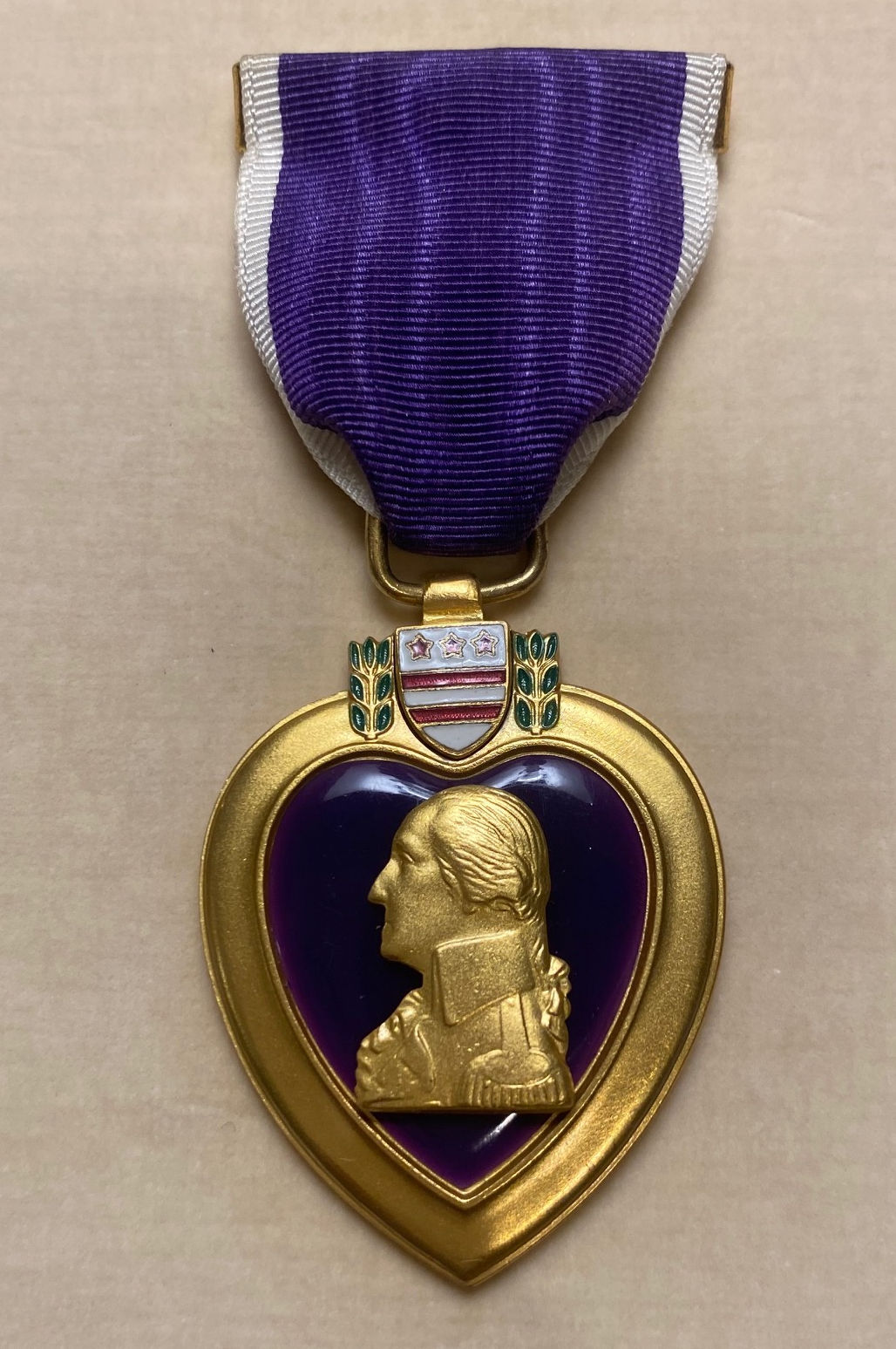
He was awarded the Purple Heart, posthumously. His name is inscribed on the Tablets of the Missing in the Manila American Cemetery, Fort Bonifacio, Taguig, Philippines.
David, you are not forgotten.
Source Credits1940 US Census, CA, Los Angeles Co., East Los Angeles, Montebello Twsp. Enumerated April 19, 1940. HH #522, South McDonnell Street; citing family of Timothy H. Park.
Our Iowa Heritage, WWII USN Pre-flight School; citing curricula of pre-flight training. Online at https://ouriowaheritage.com/navy-flight-school/
USN, USS Indianapolis CA-35, List of Officers - Month of Feb 1944; Declassified NND 803052; citing D. E. Park #363980 first reported for duty 7/19/44.
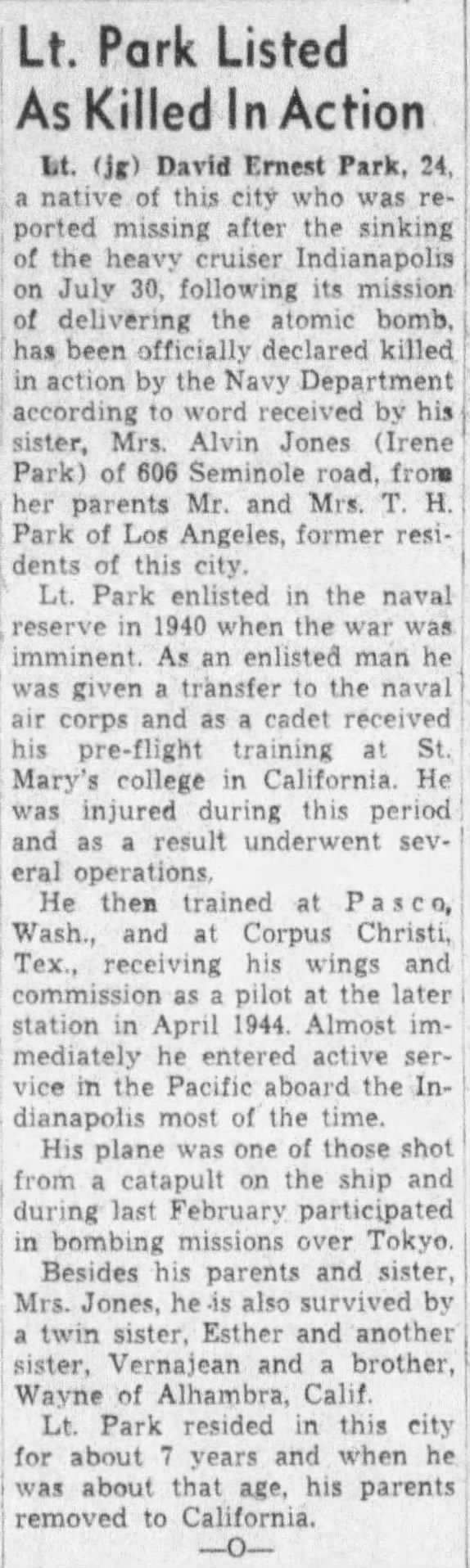
Chillicothy Gazette, (Ohio), Tue, Sep 25, 1945, p. 10; citing death of David Ernest Park
Chillicothy Gazette, (Ohio), Wed, Sept 19, 1945, p. 12; citing extended death notice of David Ernest Park
Navy Department, Casualty Section, Office of Public Information (1946): Combat Connected Naval Casualties, WWII, by States; Vol. AL-MO; CA, p. 68; citing David Ernest Park, ENS, s/o Mr and Mrs Timothy H. Park, Los Angeles.
Chillicothe Gazette, (Ohio), Wed, Sep 15, 1954, p. 3; citing Chloe McClannahan Park, mother of Ens. David Park
 Rank / Rating: ENS-Ensign