Earl was born Jan 5, 1919, the second child of Earl Randolph and Irma Faye Boyce Johnston who married May 25, 1916 in Tulsa, OK. His older sister was Alma/Anna Faye Johnston.
The 1920 census Tulsa, OK, shows Earl, 30 yo and Irma Johnston, 24 yo, with two children in the home: Anna F. Johnston, 3 yo and Earl Johnston, 1 10/12 yo., both born in OK.
Apparently, Earl's parents, Earl Randolph and Irma Faye Boyce Johnston, divorced after 1920. His mother remarried by 1930 to Rolla Edmond Richey and remained in Tulsa, OK. Earl Randolph Johnston died Mar 20, 1943 in Houston, Harris Co., TX.
The 1930 Tulsa census shows Rolla E. Richey, 35 yo, and wife Irma, 35 yo, born in Indiana. Four children are in the home: Alma Richey, 13 yo, daughter, Earl Richey, 11 yo, son, Florence Richey, 5 yo, daughter and Robert Richey, 1 month old, son.
Earl graduated in 1938 from Central High School in Tulsa, OK where he was a member of the marching band. His senior year, Earl was enrolled in the "Co-Operative" program where his time was divided between the classroom and work in the community.
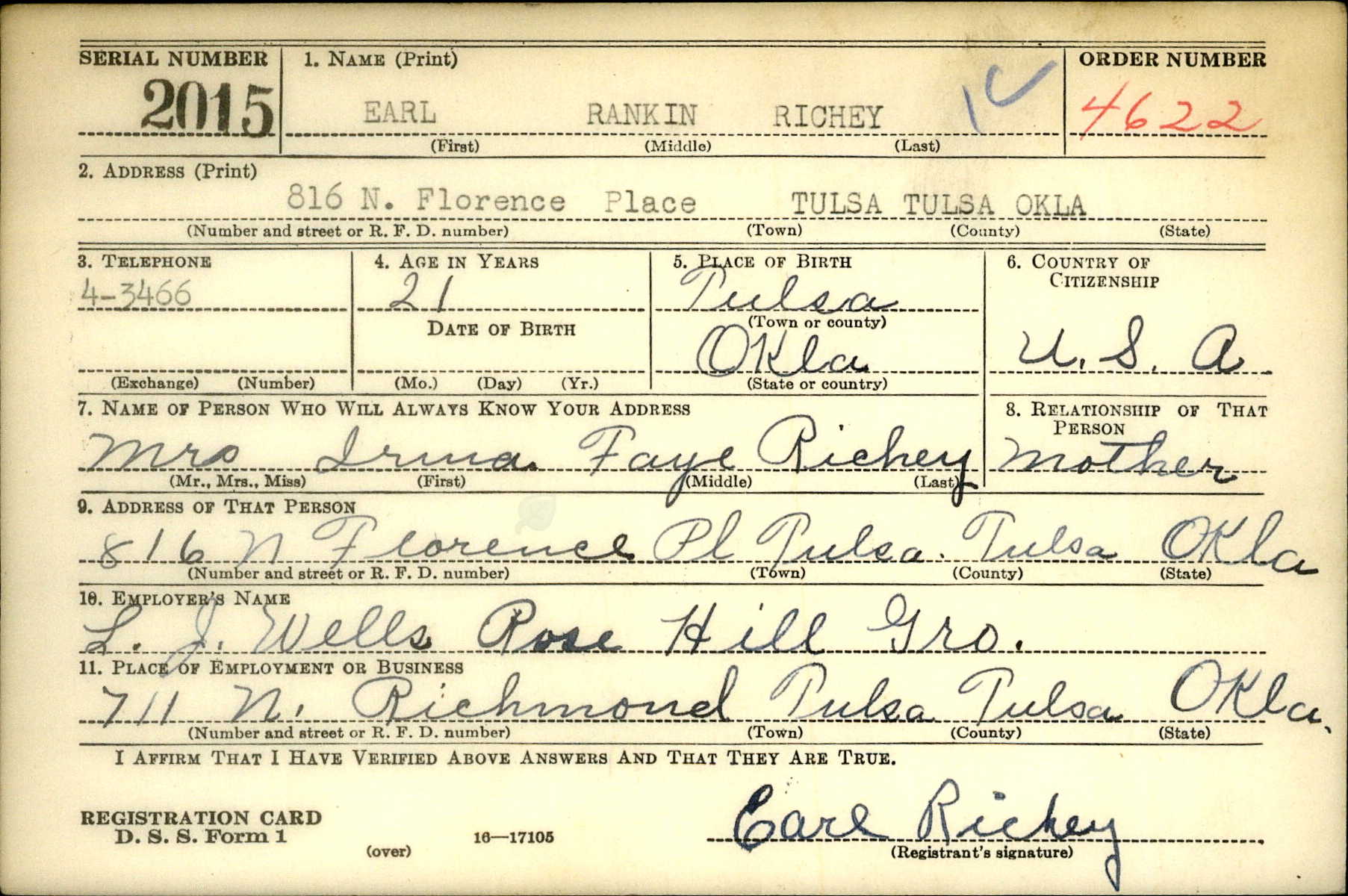
The 1940 census records R. E. Richey and his wife, Irma Fay. In the home is Earl Richey, 21 yo, Florence Elaine Richey, Robert E. Richey and Gloria Ann Richey, listed as sons and daughters. The family was still living in Tulsa, OK.
On Fri, Feb 20, 1942, the Tulsa World newspaper published a list of names of "Navy Recruits" announced on Thurs, Feb 19th that included "Earl Rankin Johnston, 816 North Florence place."
Two months later, Thur, April 23, 1942, an article entitled, "Names Changes Frequent on Court Records" appeared in The Tulsa Tribune. Numerous examples were given of people using surnames that differed from their birth surname, yet their name was never changed legally. One example was "Earl Rankin Johnston of Tulsa didn't bother about his name until he tried to enlist in the navy and found he was really Earl Rankin Richey. He'd taken his stepfather's name but had to go to court to make it legal."
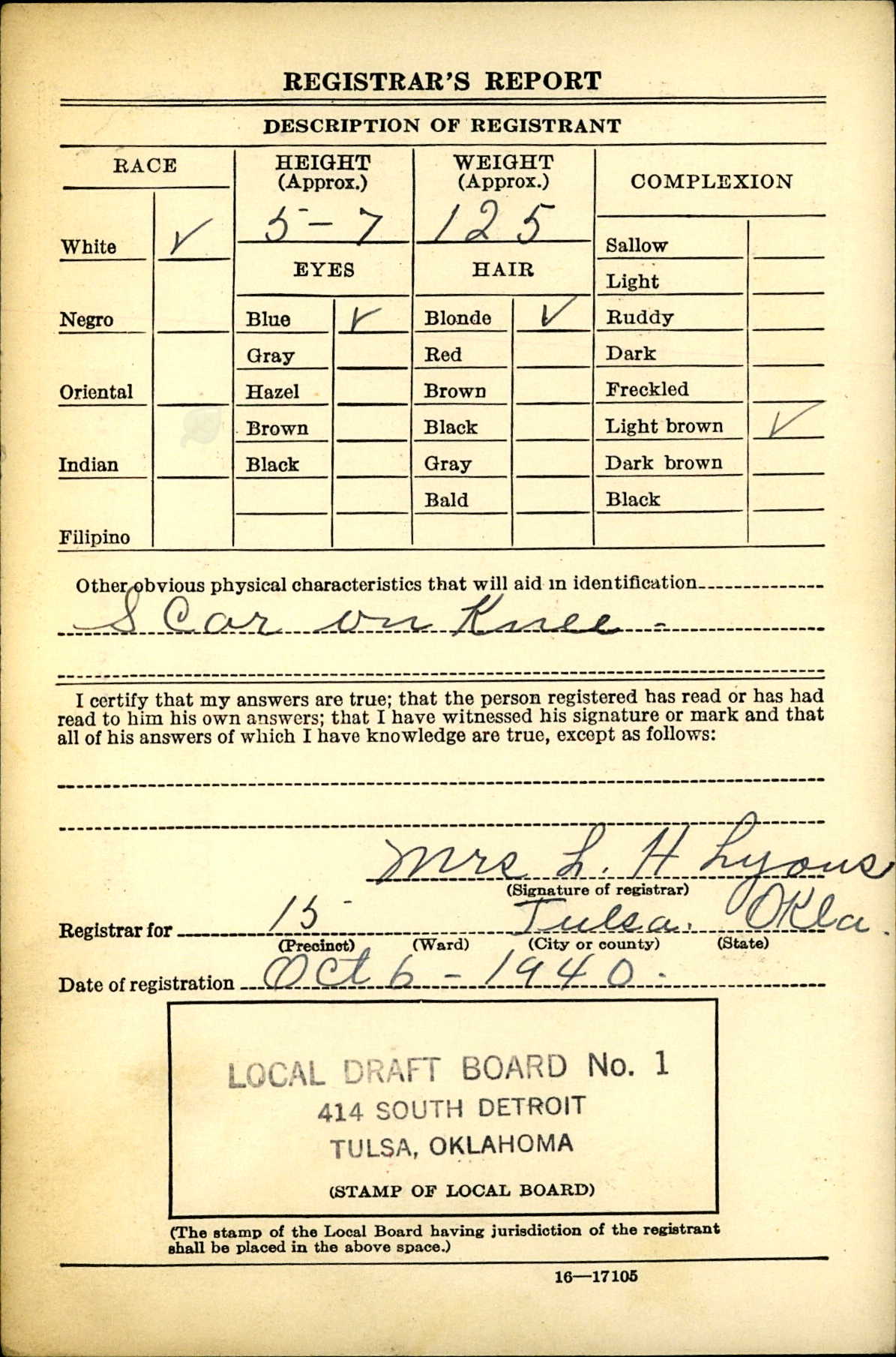
The article is a bit confusing. What the author was attempting to explain is that Earl Rankin Johnston knew his birth surname was Johnston but his mother began listing him with the surname of his step-father, Rolly E. Richey. Earl was probably under 10 years of age when this occurred. Therefore, for at least ten years his name was recorded as Richey and this is the name he used when he registered for the draft Oct 6, 1940. Because there was a paper trail with his name as Richey and there was no legal name change from Johnston to Richey, his name had to be corrected, or proven, legally before the navy would accept his enlistment.
On Feb 19, 1942, The Tulsa Daily Legal News published legal activity for the month of Feb. Three listings for Earl were shown: Case #70628 was introduced by Earl's attorney, the case was filed, and Judge Shaw granted the re change of name - "Earl Rankin Richey name changed to Johnston."
With Earl's name now legally re changed, he enlisted in the US Navy on Feb 25, 1942 at Oklahoma City, OK.
From Oklahoma, he was received Mar 14, 1942 at the Navy Training Station, San Diego, CA as a AS (Apprentice Seaman), USNR, V-2, where he remained until Apr 5th when he was transferred to San Francisco for assignment by ComSerFor, Pacific Fleet.
His assignment was on board USS Indianapolis CA 35 and he went aboard Apr 13, 1942 at San Francisco. Only eight days later, Earl went to sea for the first time when Indianapolis departed San Francisco on April 22, 1942. It would be a long trip that he likely never expected.
Indianapolis steamed from San Francisco on convoy duty to Melbourne, Victoria, Australia, over 6,000 nautical miles. The trip was slow and port was not reached until 20 days later. The temperate climate of Melborne was likely pleasant that spring, but Earl would have little time to enjoy his new surroundings. Indy remained in port only three days before steaming on May 16th to Pearl Harbor, Oahu, HI., arriving May 27th. The tropical weather in the Central Pacific was the last Earl would see for months. Two days later, Indy steamed for Kodiak, Alaska in the Northern Pacific.
The weather in the Aleutians was extremely harsh and dangerous. The crew encountered frequent violent storms, blizzards, high winds, and heavy fog. Despite the brutal service, Earl performed his job well and was advanced on Jun 25, 1942 to S2c (Seaman 2nd class).
He saw his first battle action on Aug 7th when Indy's big guns fired 120 salvos on Kiska Island as part of the operation to reclaim the area from the Japanese. However, this action came at a price. One of Indy's two planes failed to return to the ship. The pilot, nor the plane, was ever found. The reality of war became clear to Earl and he likely wondered if he would ever return home.
Indy remained in the Aleutians patrolling, on convoy duty and conducting training exercises. On Oct 1st she served as part of the covering force for the occupation of Adak, AK.
On Nov 16th, she steamed for Pearl Harbor, arriving on the 22nd. Earl had been on board for seven months and his time on dry land had been rare and was measured in hours. He welcomed the sunshine, warm weather and time he would spend ashore over the next four weeks while Indy was in dry dock for overhaul, repairs and a major refitting.
At Pearl Harbor, on 1 Dec 1942, Earl advanced from S2c to S1c, just weeks before Indy departed the harbor on 22 Dec. He would spend Christmas at sea en route back to the Aleutians. New Year's day 1943 was more than a celebration of the new year. While moored at Dutch Harbor, Earl was advanced to Cox, essentially the rate and rating of a boatswain's mate third class.
In the Aleutians, Indy joined Task Group 8.6. In Jan and Feb, Earl saw action at Amchitka, then at Holtz Bay and Chichagof Harbor, west of Attu Island.
On Feb 19, 1943, Indy was patrolling with screening destroyers southwest of Attu and made contact with an unidentified transport. Indy opened fire with her 8" battery. The ship exploded and sank. Wreckage (life jackets and other debris) identified the vessel was the Japanese cargo ship Askagne Maru, carrying ammunition (which caused the explosion). There were no survivors.
The miserable conditions of the Aleutians ended when Indy returned to Mare Island. She arrived 10 March 1943 for overhaul and repairs. Earl was likely grated leave to visit his family back in Oklahoma. He had not been home in 12 months.
After 10 days of training exercises of CA, Indy departed San Francisco on 15 May, 1943 sailing to Kulak Bay, Adak Island, AK where she anchored on the 23rd. Earl would once again face harsh weather conditions.
On May 25, 1943, Indianapolis of TG 16.5.16 joined up with TG 16.6, Southern Covering Group (SCG) Operating off Attu. She remained with the TG until the afternoon of the 27th when she joined TG 16.12 in the Northern Covering Area off Attu. She continued service until June 3rd when organized resistance of Attu had been eliminated. She was released from the TG the next day and was ordered to TG 16.12 and continued patrolling the Northern Area until June 29th when she returned to Kuluk Bay. Indy was awarded a battle star for her service in the operation.
After Attu was proclaimed secure, the US forces focused their attention on Kiska, the last enemy stronghold in the Aleutians. On Aug 2, 1943, Indianapolis joined the other small ships of a task force and trained her 8-inch guns, destroying shore-based Japanese hideouts and other facilities on Little Kiska Island.
As part of TG 16.6.2, on Aug 12th, Indy launched her four planes to serve as spotters shortly before she trained her main battery on Gertrude Cove, Kiska Island. She then trained her 5" battery at Bukti Point on Kiska. This was a lucky day for Earl as there was no return fire and all planes were recovered safely.
Indy remained on patrol and in a supportive roll until Aug 25th when she departed for San Francisco and forward to Mare Island, Vallejo, CA for overhaul and refitting. Basically, Earl's feet had not been on land for four months, but he had earned his first battle star. There would be no time for leave or much time ashore.
Indy sailed for Pearl Harbor on Sept 7, 1943. She would remain there and conduct training exercises until early November.
On Nov 5, 1943, Earl would have his first experience on board a flag ship when Vice Admiral, later Admiral, Raymond A. Spruance came aboard Indianapolis as Commander of the Central Pacific Force, 5th Fleet.
Earl headed for further battle action when Indy left Pearl Harbor on Nov 10th bound for the Gilbert Islands and "Operation Galvanic" against Tarawa and Makin islands. On 19 Nov 1943, Indy, in a force of cruisers, bombarded Tarawa and next day pounded Makin. The ship then returned to Tarawa and acted as a fire-support ship for the landings. That day her guns splashed an enemy plane and shelled enemy strong points as valiant landing parties struggled against fanatical Japanese defenders in an extremely bloody and costly battle. She continued this role until the leveled island was declared secure 3 days later. [DANFS]
returned briefly to Pearl Harbor on Dec 11, 1943 and embarked passengers for transport to Mare Island, CA. Indy would remain in port at Mare Island for Christmas and New Year's Eve.
At the time, Indy was the only large ship moored at Mare Island. The crewmembers "dressed" Indy for Christmas. Multi-colored lights were strung along the rigging. A large "Merry Christmas" banner awaited everyone who walked the gangway and a large lighted tree was erected on the quarterdeck. These little touches of home surely helped ease Earl's heart aching desire to be home with his family.
Most men were granted at least a few hours of leave on Dec 31st. It would be their last for quite a while. The realities of war could no longer be set aside. It was time to return to the war zone.
Indy departed Mare Island on New Year's Day for San Francisco. She stayed only long enough to embark officers and passengers for transport to Pearl Harbor where she arrived on Jan 7th.
She departed the harbor bound for the Marshall Islands to aid in the actions against Kwajalein and Majuro Atolls in late January. Indy entered Kwajalein lagoon on Feb 4th where she remained until the area was secured. Her service ended in the Gilberts after supporting the occupation at Eniwetok.
Steaming to the Western Carolinas, Indy took part in the raids on Palau, Yap, Ulithi and Woleai. On April 10th she left Majuro for Pearl Harbor and on April 22nd she arrived back in San Francisco, CA and on to Mare Island for overhaul. Earl was not likely granted furlough because Indy would be in port only eight days before steaming back to Pearl Harbor on May 1st.
When Indy returned to the Pacific, the Central Pacific Force in which she formerly served was now designated the Pacific 5th Fleet and continued under the command of now Admiral Spruance.
This would be a period of brutal service for Earl. From June to Oct 14, 1944, Indy took part in the capture and occupation of Saipan, Battle of the Philippine Sea, the capture and occupation of Guam, the capture and occupation of Tinian in the Northern Marianas Islands and on to the Western Caroline Islands operation for the capture and occupation of southern Palau Islands.
Earl arrived back at Mare Island, CA on Oct 19, 1944 where Indy underwent overhaul and a major refitting following her long Pacific service. In addition, new paint would be applied to the inside and the proud ship would be given a facelift - new camouflage. Her measure 32/7D pattern dazzle camouflage, applied six months earlier, was replaced with measure 22, modified.
For the work to be completed, the crew was removed from the ship. Most enlisted men moved to the barracks at the Navy Yard. Many were sent for additional training or service school during this time.
On Nov 1, 1944, Earl was advanced from COX to BM2c(T). The (T) indicated a temporary advancement and was the policy of the Navy at the time due to belief that the war was dwindling down. Even so, this was a proud day for Earl. He had studied, trained and been tested over the past 22 months to qualify for this advancement.
Earl would spend Christmas and the beginning of the new year on dry ground and likely was granted leave during this time.
With repairs and new paint completed, Indy conducted numerous short trials between Mare Island, San Francisco and San Diego. On Dec 28, 1944, Captain Charles Butler McVay, III, assumed command of Indianapolis. She departed Mare Island on Jan 3, 1945 for San Francisco, then San Diego and forward to Pearl Harbor. On Jan 20th, Adm. Spruance came back aboard.
Earl arrived with his ship on Feb 1, 1945 at Ulithi Atoll, two weeks before she made the first attack on Tokyo on Feb 14th. Throughout the action, Indianapolis played her vital role of support ship. She sailed on to Iwo Jima where action began on the 19th. Indianapolis did her share of the bombardment of the island where Japanese soldiers hid in and attacked US forces from subterranean tunnels. She moved back to Tokyo to Honshu and Nansei Shoto for more bombardment of the islands and remained until the operation ended on Mar 1st.
During the Iwo Jima operation Indianapolis was hit by a Japanese kamikaze plane on Mar 31st. Nine men were killed and 20 injured. Earl was not injured. Indy limped back to Mare Island, CA, for repairs and refitting, where she would remain for two-and-a-half months. Most assuredly, Earl was granted leave to visit his family.
Earl was awarded 1 silver star, representing 5 bronze stars, and 4 bronze stars to place on his Asiatic-Pacific ribbon representing the 9 battle stars awarded to Indianapolis since he had been on board.
At Mare Island, Earl and his shipmates prepared for a top-secret delivery to the island of Tinian in the Northern Mariana Islands. No one on board knew the contents of their cargo when they departed on July 16, 1945.
After the delivery, Indianapolis departed Tinian and after a short stop at Apra Habor, Guam, she sailed for Leyte, her final destination. Half-way there, on July 30, 1945, Indy was struck by two torpedoes from Japanese submarine I-58 and sank in 12 minutes. Whether Earl made it off the ship and into the water is not known.
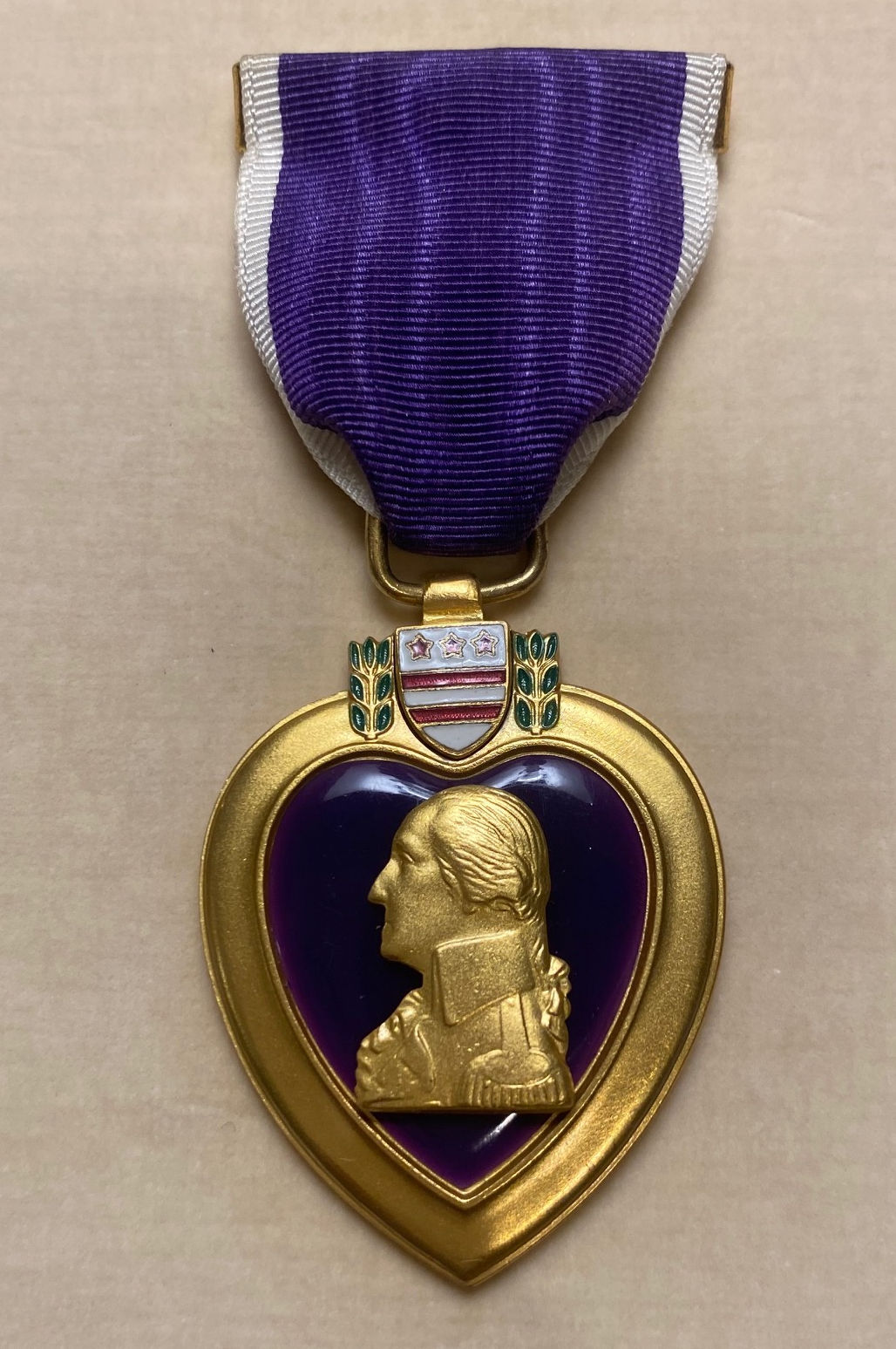
Earl was awarded the Purple Heart, posthumously. His name is inscribed on the Tablets of the Missing in the Manila American Cemetery, Fort Bonifacio, Taguig, Philippines.
A cenotaph was placed in Rose Hill Memorial Park, Tulsa, OK, where his parents are buried.
Earl, you are not forgotten.
Note: The photo of Earl was submitted by his sister, Elaine Venable of Ardmore, OK, to Mary Lou Murphy in about 2008 for publication in Lost At Sea But Not Forgotten.". No information about the photo was provided, but it was taken after Nov 1, 1944 when he was advanced to Boatswain's Mate 2nd class. Note the insignia on his right sleeve.
Source CreditsMurphy, Mary Lou, (Ed.), (2008). Lost At Sea But Not Forgotten by USS Indianapolis Families. Printing Partners, Indianapolis, IN. (Copyright 2025 by Project888.org, granted from Mary Lou Murphy and Printing Partners).
OK, Tulsa Co., Marriage Record, 1915-1919, p. 402
OK, Tulsa, Central High School, "The Tom Tom" yearbook, 1938; citing senior photo of Earl Richey.
1920 US Census, OK, Tulsa, Tulsa City, Precinct K. Jefferson St.; HH# 212. Enumerated Jan 13, 1920; citing family of Earl Johnston.
1930 US Census, OK, Tulsa, Tulsa City, Gorden Place Twsp, Dist 72-77. 816 North Florence, Family # 343. Enumerated April 14, 1930.
1940 US Census, OK, Tulsa, Tulsa City, 816 North Florence, Family # 284; citing family of R. E. Richey
Date first aboard ship as record in the ship muster rolls.
The Tulsa Tribune, Mon, July 16, 1945, p. 12; "Fighting Oklahomans", citing names of men from Tulsa, OK on board Indianapolis at Okinawa.
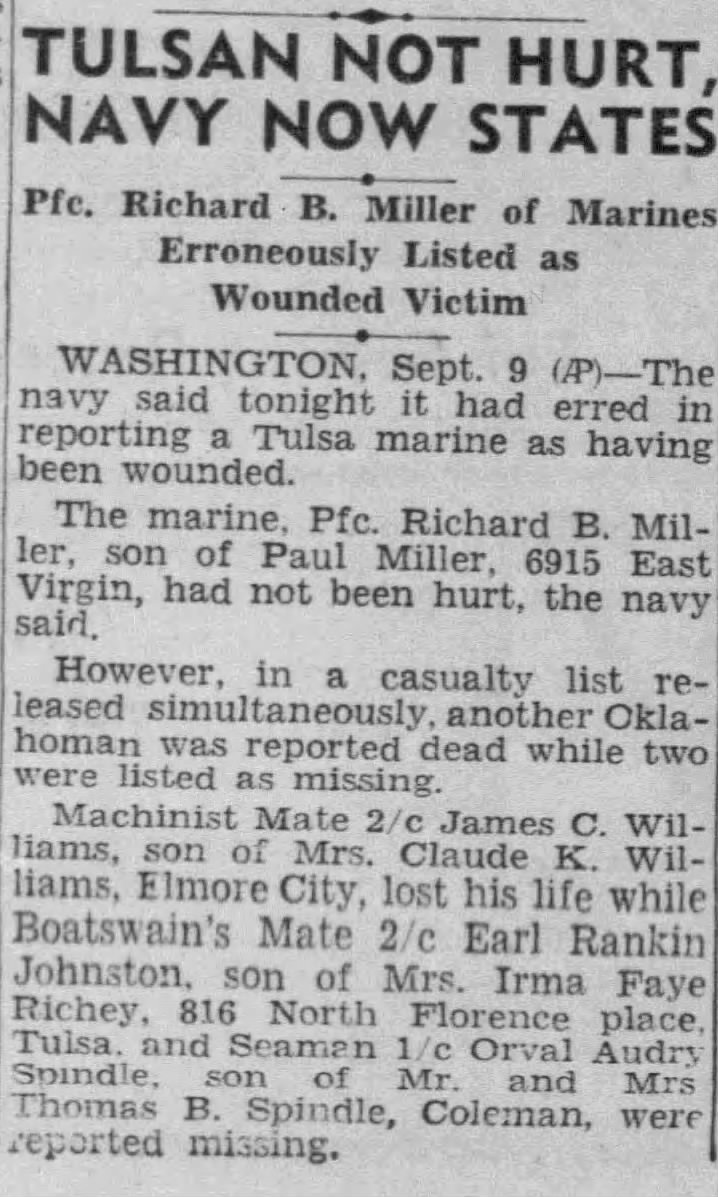
Tulsa World, (OK), Mon., Sept 10. 1945, p. 1; citing MIA
Navy Department, Casualty Section, Office of Public Information (1946): Combat Connected Naval Casualties, WWII, by States; Vol. MT-WY; OK, p. 7; citing Mrs. Irma Faye Richey, mother.
Find a Grave, database and images (https://www.findagrave.com/memorial/180166587/earl_rankin-johnston: accessed December 1, 2025), memorial page for BM2 Earl Rankin Johnston (5 Jan 1919-30 Jul 1945), Find a Grave Memorial ID 180166587, citing Rose Hill Memorial Park, Tulsa, Tulsa County, OK.
Murphy, Mary Lou; (2008), Lost At Sea But Not Forgotten, Printing Partners, Indianapolis, IN. Copyright 2024, project888.org.
 Rank / Rating: BM2-Boatswain's Mate Second Class