USS Indianapolis CA-35
Lost At Sea

Donald Martin POKRYFKA
Name: Donald Martin POKRYFKA
Lost at Sea Donald Martin POKRYFKA Rank / Rating: S2-Seaman Second Class
Service #: 314 69 69
DOB: Jan 03, 1928
From: Detroit, MI
Parents: Leo Frank and Angeline Wroblewski Pokryfka
Went Aboard: May 12, 1945
Age When Ship Went Down: 17 years, 6 months, 27 days
Spouse:
Children:
Grandchildren:
Bio Submitted By: Patricia Stephens (Admin)
Date Posted: Jun 08, 2026

Lost at Sea Donald Martin POKRYFKA
POKRYFKA, Donald M
[Note: The surname was spelled Pokryfke in most public records and the WWl and WWll draft registrations of Donald's father. Also, the military records of Donald's brothers spelled the name Pokryfke. Donald's military records spelled the name Pokryfla.]
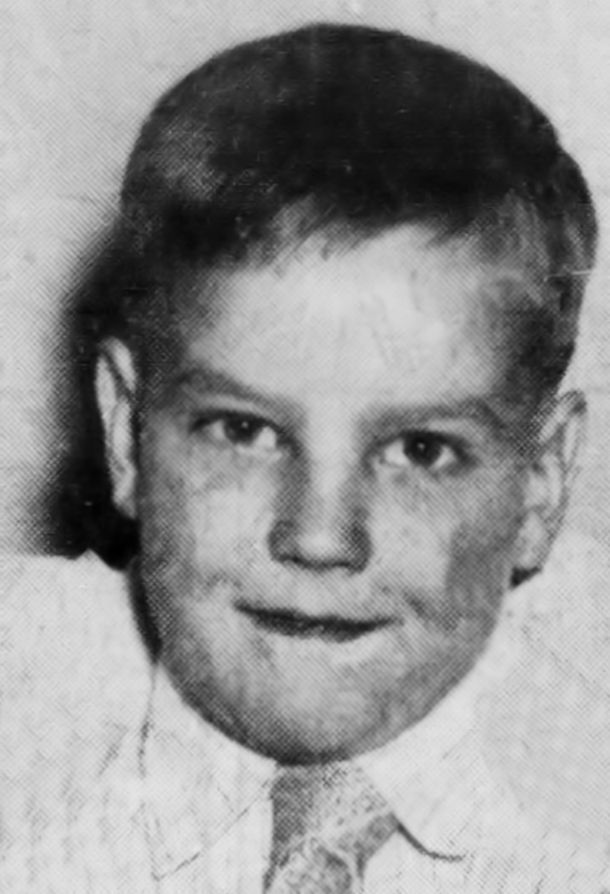
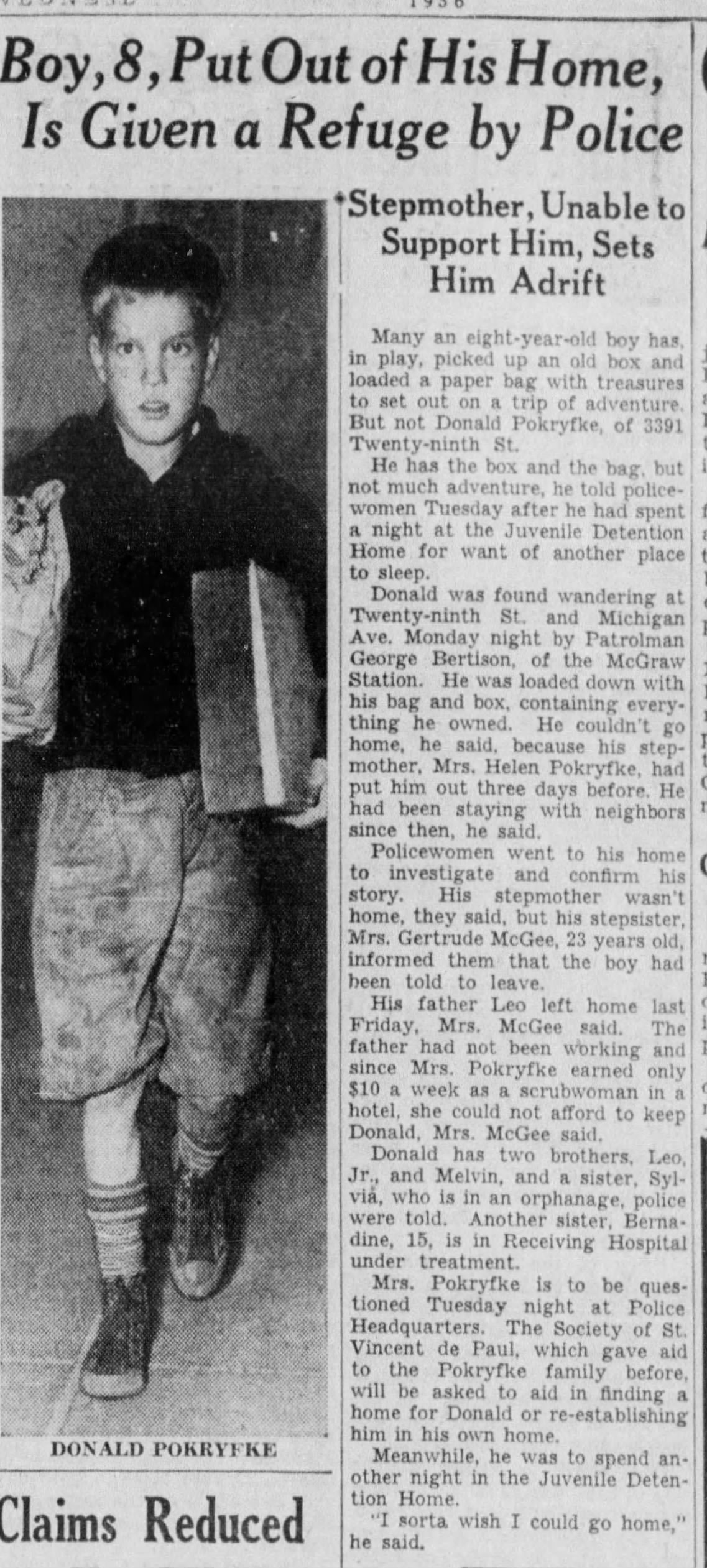
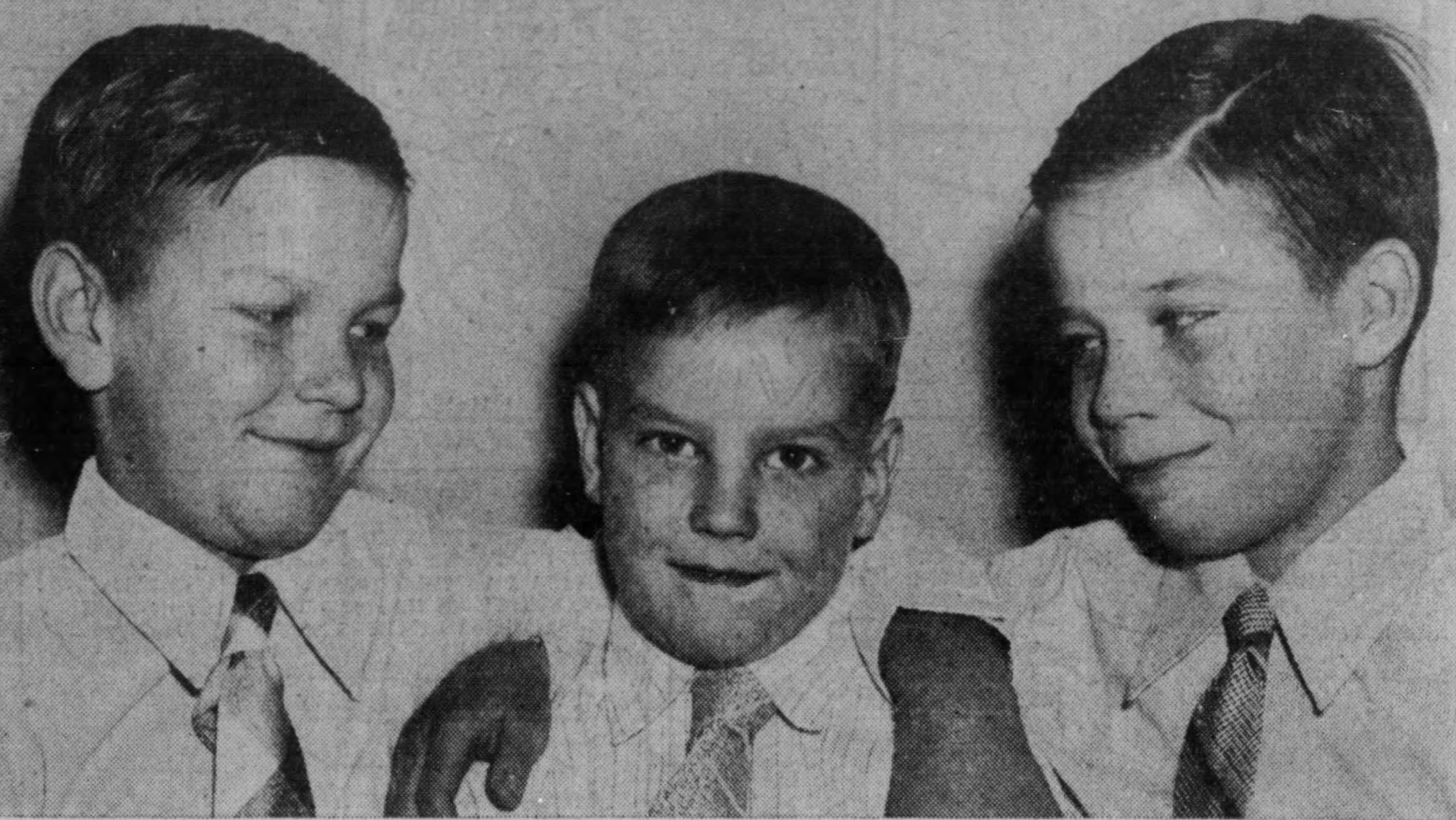
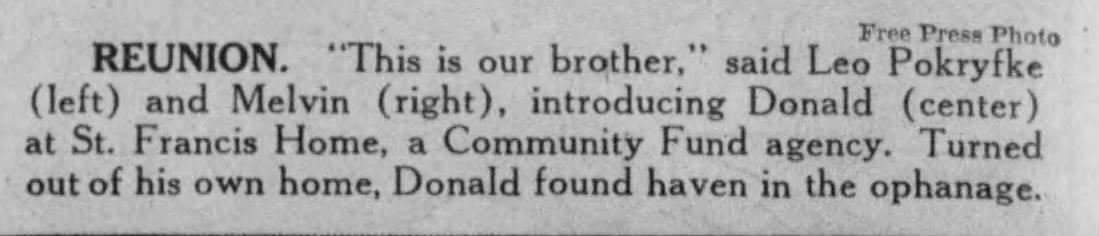
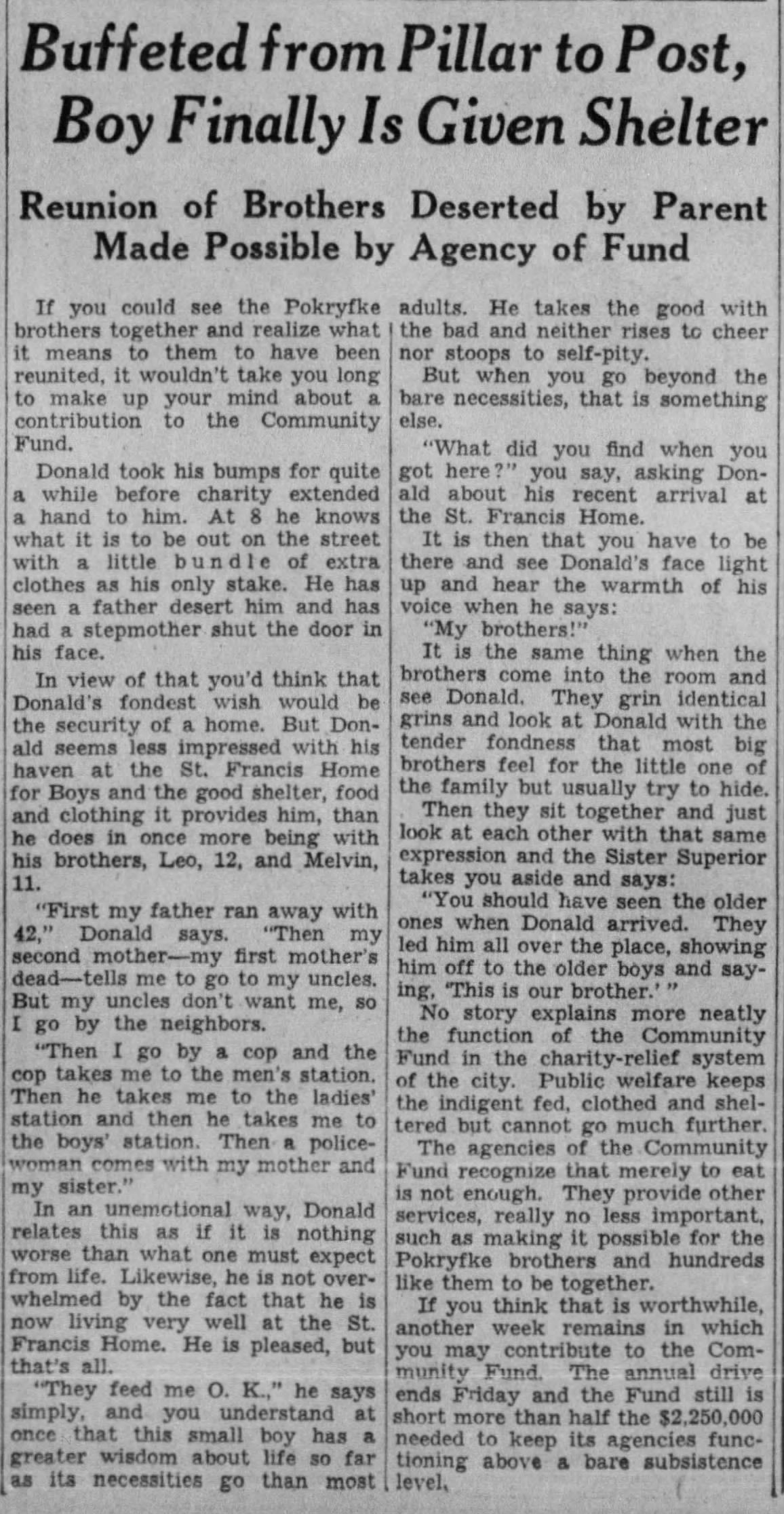
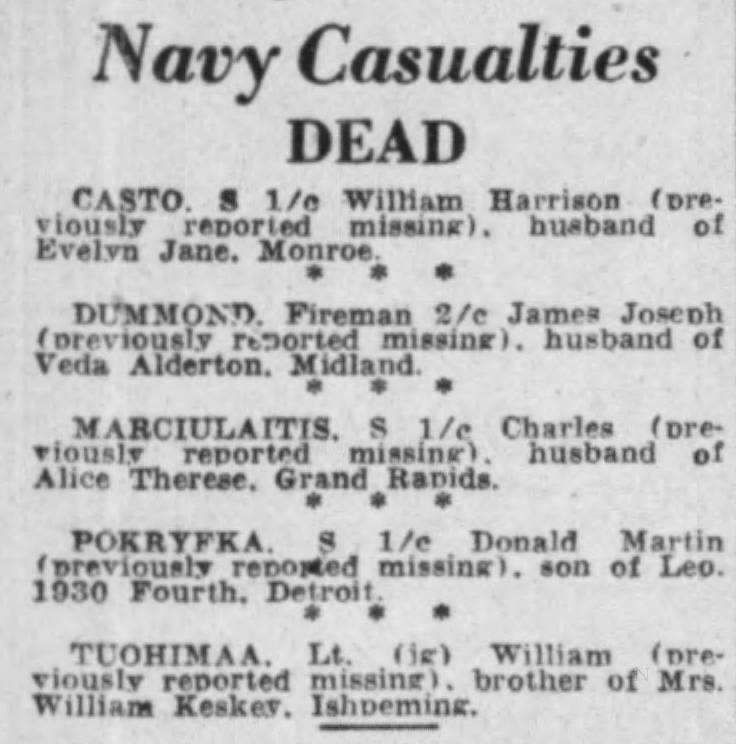
Donald Martin Pokryfke was the son of Leo Frank and Angeline "Nellie" Wroblewski Pokryfke of Detroit, MI. Leo was born Aug 3, 1894 in Michigan and was the son of prussian/polish immigrants, Frank and Annie Pokrefke. Angeline was born May 17, 1898 and the daughter of Anthony and Mary Wroblewski, of german/polish descent. They married in Detroit on May 8, 1917, when he was age 22, and she was age 18. The following month, on June 5, 1917, Leo registered for the WWI draft in Detroit. He wrote that he was 22 years old, married and with one child.* He claimed an exemption based upon having a wife and child totally dependent upon him for their support. (*No birth record or any other reference to this child was found. This may have been a child of Angeline's born before their marriage. Also, it is possible that Leo was not be truthful). The 1920 Detroit census showed Leo, age 26, was working in a auto factory and Angeline was age 21. They had a daughter, Florence, age 1 year 5 months old, establishing birth date of cJuly 1918. By 1930, the family was living in Warren, Macomb Co., MI. The census recorded Leo F. Pokryfke, age 35, born in Michigan. His age at first marriage was 21. He had worked as a mechanic in an auto manufacturer, but was unemployed at the time of the census. Angeline L., wife, age 22, but this is an error. Her age was 32. She was born in Michigan, her parents born in Germany. Her age at first marriage was 18. She was now the mother of six children: Florence E., age 11; Bernadine A., age 9; Sylvia A., age 7; Leon R., age 5; Melvin F., age 4; and Donald C., age 2. The children were all born in Michigan. Two years later, tragedy struck the family. Angeline died of cancer on Sept 24, 1932, at age 34. Donald was only 4 years old. His oldest sister was only 13. At the time of Angeline's death, the family was living on Lovett Ave, Detroit. One year later, on Sept 2, 1933, Leo married Helen K. [unknown], but the marriage would last less than three and a half years. On about Oct 2, 1936, Leo "abandoned" his wife, step-daughter and son, Donald. Helen filed for divorce. Where Leo's other minor children were living at the time he left Helen's home is not known with certainty, but their location would later be revealed. On Oct 7, 1936, five days after Leo disappeared, a photo, shown below, and story appeared in the Detroit Free Press. Donald Martin Pokryfka, age 8, was shown holding a paper sack under one arm and a small cardboard box under the other containing his only possessions. Police had found him roaming the streets of Detroit after he was told by his step-mother to leave the home because she could no longer support him financially after his father abandoned her. Donald had been sleeping with various neighbors for several nights. The photo showed a filthy child with a blank stare in his very young eyes. At the police station, Donald told the officer he had two brothers, Leo, Jr. and Melvin, and a sister who was living in an orphanage. Another sister, Bernadine, 15, was "in Receiving Hospital under treatment." The police arranged for Donald to be taken to "the Society of St. Vincent de Paul, which gave aid to the Pokryfke family before." The Society was/is an international Catholic lay organization dedicated to serving the poor, suffering, and deprived through direct, personalized assistance. As stated, the family was known to the society. Five weeks later, a second story appeared in the paper on Nov 14, 1936. A photo showed three young boys with the caption, "This is our brother said Leo Pokryfke (left) and Melvin Pokryfke (right), introducing Donald (center) at St. Francis Home, a Community Fund agency. Turned out of his own home, Donald found haven in the orphanage." As told in the above photo caption, Donald's two brother were already living in the orphanage before his arrival. How long they had been living there is not known, but it had been four years since their mother's death. Leo was now 12 and Melvin was 11 years old. Another article, published the same day, announced a continuing fundraiser for the "Community Fund" which supported the "St. Francis Home for Boys" orphanage and told the story of Donald and his brothers. Donald was quoted as saying, "First my father ran away with 42."*. Then my second mother - my first mother's dead - tells me to go to my uncles. But, my uncles don't want me, so I go by the neighbors. Then I go by a cop and the cop takes me to the men's station. Then he takes me to the ladies station and then he takes me to the boys station. Then a policewoman comes with my mother and my sister." Describing the orphanage, he said, "They feed me O.K." When he was asked what he found when he arrived at the home, it was said that "his face lights up and [you] hear the warmth of his voice when he said, "My Brothers!" (*It is unknown what he meant by "42.") The brother's reaction to seeing Donald was described as, "they grin identical grins and look at Donald with the tender fondness that most big brothers feel for the little one of the family but usually try to hide." The brothers "led him all over the place, showing him off to the older boys and saying, 'this is our brother.'" It is assumed the boys remained together at the orphanage for the next six years. Their names could not be located on the 1940 census. The orphanage opened in 1898, but moved to new locations, the last move in 1917 to a new five-story building on the corner of Fenkell and Linwood Avenue. Interestingly, the home became a military school beginning in 1942, but the exact date is not known. Melvin turned 17 years old on Aug 15th and on Aug 17, 1942, he and Leo, now 18, traveled together to the Detroit Recruiting Office and enlisted in the US Navy. At the recruiting office, Melvin and Leo gave their address as 4000 Lincoln, Detroit(1). Whether they had benefited from the new military curriculum at the orphanage or if it influenced their decision to enlist is not known. Regardless, it had to be a very difficult decision and heartbreaking to leave Donald behind, but he was only 15 years old. The boy's father, Leo, continued to live in the Detroit area. He registered for the "old man's" draft on April 27, 1942 in Detroit. He was 47 years old and living with a Mr. Harry Terosen on 3rd Street. Their relationship is unknown. Leo was employed by the Hudson Motor Company. One can have little doubt that Donald had lived his childhood and pre-teen years filled with sorrow, hardship and despair that most adults would never accumulate in their lifetime. Now, his brothers were gone and he was once again alone. Even though it was the only stable home he had ever known, he surely counted the days until he turned 17 and could legally leave the orphanage to follow in the footsteps of his brothers. Donald's day arrived on Feb 16, 1945, one month after his 17th birthday. He hurried to the recruiting office and enlisted in the US Navy. At 17, the Navy required the consent of a parent to enlist. It is unknown who signed the consent. It is possible he forged the signature. He likely knew that if he could serve, without getting caught, until his 18th birthday, the Navy would not send him home. There is a possibility that the orphanage had legal custody of Donald and they gave consent. Whatever Donald told them or papers he presented, the Navy had no questions and allowed him to enlist. He was now a sailor. He knew little of the world outside his neighborhoods around Detroit and sheltered life in the orphanage. But, no doubt Leo and Melvin had written him letters describing their new life out in the world and in the Navy. With the determination of any youngest son, Donald looked up to his big brothers and knew he could do anything they could do. He boarded a train in Detroit for the 300 mile trip to Great Lakes, IL., for bootcamp. Like the paper bag he carried when he was told to leave his home, he would carry another one this day that contained the three days of clothing he was ordered to bring. No other personal items were allowed so he would have to leave his box behind. The next few days would be both exciting and terrifying at the same time. He arrived at Great Lakes on Feb 20th. The nuns at the orphanage had demanded proper behavior and Donald doing what he was told. This would serve him well when he faced the rigorous training and constant orders during basic training. He likely showed the same attitude he had shown at the orphanage when he was described as telling the story of being abandoned "in an unemotional way, as if it is nothing worse than what one must expect from life." Donald proved his worth at bootcamp and was very proud when he was advanced to S2c (Seaman 2nd class) on April 11, 1945. On April 23rd he received orders to report to Shoemaker, CA. It seemed a world away. His next train ride would be long, but he now knew what to expect. This time he carried only a white cotton duck canvas duffel bag stamped with U. S. Navy and his name in block letters. The items inside were only what he had been issued at bootcamp. He wore a standard blue Navy enlisted uniform, likely the nicest clothes he had ever worn. He thought he looked very handsome in the navy blue pull-over top with a white neckerchief, tied according to Navy regulation, and matching blue bell-bottom pants. His issued shoes were clean and laced tightly. He would have to remember to keep his white "dixie cup" sailors cap square on his head at all times. Even though he may have preferred it on the back or to the side of his head, that was against regulations. He knew there would be guards on the train watching his every move, so there was no room for nonsense. After numerous stops and little sleep, Donald arrived at the receiving station at Shoemaker on April 27, 1945. He had likely never seen such a large facility or so many men gathered in one place. This station processed several thousand men each day. He would remain there in the barracks for two weeks and was probably given time to see and enjoy the city and surrounding areas. What an overwhelming experience it must have been. But, his brothers managed it and he would too. He would spend some of his time writing letters to both of them to bring them up-to-date on his training and duties. On May 12, 1945, Donald received his first duty order and was transferred the same day. He boarded a bus for the short trip to Mare Island Navy Yard, Vallejo, CA, where he saw his ship for the first time - USS Indianapolis CA 35. As Donald walked the dock he did not expect to see what he saw. There was his ship, but not in the water. She was resting on massive wooden keel blocks designed specifically for her hull and labeled with her name. Yard workers were scurrying about and busy repairing two holes in the bottom of her keel as well as one on her deck on the port quarter. Indianapolis had limped several thousand miles back to Mare Island for repairs from a kamikaze attack off Okinawa on March 31, 1945. She had been temporarily repaired at Kerama Retto with additional emergency repairs at Guam. She had arrived at Mare Island on May 2, 1945. Donald walked the gangway and was granted permission to come aboard. Part of the enlisted and officers were kept on board even in dry dock, but most of the crew was moved to the barracks at the Navy Yard, sent to schools for additional training or granted furlough. Over 200 crew members would be transferred off the ship and replaced before she returned to the Pacific. Donald was one of the replacements. Others would stream on board over the next few weeks. Donald may have spent his nights in the barracks and days on board the ship. Any dreams Donald had of immediately setting sail on the high seas were dashed. But, this did not matter. He now had a new home. As a Seaman 2nd class he most likely was assigned to the deck crew. He would be taught basic deck cleanliness and maintenance, line handling used to anchor or moor the ship, duties of standing watch, small boat handling and other basic jobs. However, for now, he would be assigned where he was needed. When the ship was floated out of dry dock on June 22nd, more crew would spend their time on board assisting yard workers with repairs and attending to everyday duties and upkeep. Indy would be overhauled, refitted and painted. The scuttlebutt was that Indy would remain at Mare Island until about September in order for all the work to be completed. Chipping paint and rust was one of those jobs that nobody wanted but had to be done before the ship could receive her new inside paint and outward camouflage pattern. This was a job assigned mostly to new crew members of the lower ratings, like Donald. He would assist also with the painting. Despite any grunt work, Donald was settling into Navy life. He had his own bunk, clean clothes and shore leave. He had plenty to eat. Two mess halls served three meals a day and snacks and sandwiches were always available. Forty gallons of coffee were brewed at a time. The ship was like a mini-city complete with a post-office, sick bay and dental office and a small library. He would meet men from all over the US as they came aboard for duty. Life was good. July 4, 1945, was a day of celebration. In the afternoon, "Open-house" was held on board Indy. Wives, girlfriends and other friends came to see what they had only seen from the dock, if that close. Cake and ice cream was served and balloons given to the children in attendance. The Navy Yard provided a fireworks show that night. Donald was likely granted at least a few hours of shore leave that night. Only a short distance from the ship were many places that offered food, drink and entertainment and even more in nearby San Francisco. Many of his shipmates would make poor choices and received punishment for being AWOL, drinking too much or fighting. There is no record of any bad behavior by Donald even though his 18th birthday was only two days away. He returned to the ship as ordered. On July 12, 1945, with work not yet completed, Capt. McVay received an unexpected and somewhat bewildering order to have Indy ready to depart the US no later than July 16th. Telegrams were sent ordering crewmembers and officers to return to the ship immediately. All leave and service school training was cancelled. With most of the crew back on board, as well as yard workers, Capt. McVay ordered the crew to ready for departure on Saturday morning, July 14th. He took his ship on a brief trial in an attempt to not only test the ship's repairs, but give the green crewmembers some degree of training. The exercises included speed runs, emergency turns, full backdown as well as radar, radio and fire control procedures. Donald was likely overwhelmed with this crash course on his first time at sea. He would be thankful that the seas were calm. Crewmember Glen Harley Peterson wrote a letter home on July 14, 1945, describing the brief trial." "Last Monday we took our trial run out to sea to test the guns and engines. We went out about seventy miles. It wasn't too rough so I didn't get sea sick but I suppose I will when we go out. I sure hope that I don't get sick. You could really feel it when they fired those big guns. That part was kind of fun." Very early the next morning, Sunday, Indy put back into Mare Island and a few hours later, Capt. McVay received his final orders. He was to depart Mare Island that day for Hunter's Point Navy Yard in San Francisco Bay where he would receive top-secret cargo for transport to the island of Tinian in the Northern Mariana Islands. Two Navy officers would come aboard with the cargo to ensure its safe delivery. He was not told the contents of his cargo. He was to proceed at flank speed to Pearl Harbor, refuel and continue on. In the early morning hours of July 16, 1945, Indy prepared to get underway. She depart Hunter's Point at 8:00 a.m., and at 8:36 a.m., passed under the Golden Gate Bridge. After two months on board, Donald's dream of duty at sea was finally a reality. But, it was not smooth sailing. Capt. McVay ordered the crew to stay clear of the forward part of the main deck because the speed of Indy could cause large waves to break over the bow. A few hours later, Indy hit rough seas with swells of fifteen feet. Even with a slight reduction in speed, with each wave the ship rose then suddenly slammed into the troughs with a violent jarring along with a roll from side-to-side. The old salts on board had experienced a much worse ride, but Donald was not likely reassured by their calmness and secretly feared for his life. The next day, the weather improved and the screws of the four massive engines were pushing the ship along at an average of 29 knots. Indy shuttered and vibrated as she plowed through the warm water, her engines almost at their limits. High speed did not deter McVay from taking the opportunity to train his crew. He ordered General Quarters where all men were to immediately report to their assigned battle stations. Donald's battle station is not known, but, as a S2c and member of the deck division, he was likely assigned to a team manning one of the guns. Arriving at Pearl Harbor, Donald would long for just a few hours on dry land. It was not to be. No one without prior orders was allowed to go ashore. But, there was good news. Indy had steamed, averaging 29.5 knots, over 2,000 nautical miles in 74.5 hours from the Farallon lightship at San Francisco to Diamond Head, Oahu, TH, setting a new time record. The crew erupted with shouts and cheers when Capt McVay announced Indy's speed record. Indy refueled and continued her mission. Her secret cargo was off loaded at Tinian on July 26th. Before departing that afternoon, McVay received orders to proceed to Guam, 120 miles south of Tinian. The next morning she arrived at Apra Habor, Guam, where McVay received routing orders for her final destination - Leyte, in the central Philippines, 1300 nautical miles away. Indy departed Apra Harbor the next morning, Sunday, at 9:00 a.m. Half-way en route to Leyte, just after midnight on July 30, 1945, Indy was struck by two torpedoes from Japanese submarine I-58. The damage was catastrophic and she sank in 12 minutes. Whether Donald made it off the ship and into the water is not known, but his service aboard his new home ended after only 2 months and 18 days. An already broken family was forever shattered. His two brothers were still sailing the high seas, but Donald now rested beneath the waves on eternal watch. All gave some, some gave all. Donald, you are not forgotten. Navy Service of Leo and Melvin Pokryfka Leo and Melvin arrived together at bootcamp in Great Lakes, IL. In Nov 1942, both were assigned, at commissioning, to USS Atascosa AO-66, a fleet oiler. This dangerous duty was to supply fuel and ammunition to Navy ships. They would serve together for the next 18 months. Both advanced through the ratings by June 1943 to S1c. On June 1, 1944, both were advanced to COX. This is when their service together ended. Only Leo would remain aboard Atascosa. Melvin transferred to Landing Craft School in Coranado, CA and from there was ordered to USS Lubbock APA-197 on Oct 18, 1944, at commissioning. Perhaps because his brother was no longer with him, Melvin could not stay out of trouble. The ship's logs show the crew was quite a rowdy bunch and deck court was a frequent event. Twice Melvin faced deck court and was reduced to S1c. He remained a S1c at discharge from the Navy in April 1946. Leo remained on board Atascosa until Oct 30, 1944. He was transferred back to the US for duty with "new construction." On May 15, 1945, he was transferred to USS E. B. Hall APD-107. Leo was still on board when he reenlisted on May 2, 1946. He was discharged from the USN on Jan 5, 1947. Leo Russell Pokryfke, COX, USN, died of natural causes on Jan 8, 2000, age 75, and is buried in the Great Lakes National Cemetery, Holly, Oakland Co., MI. Melvin Frederick Pokryfke, S1c, USN, died on May 26, 2014, age 88, and is buried in the Great Lakes National Cemetery, Holly, Oakland Co., MI. Their mother, Angeline Pokryfke, was buried in Holy Cross Cemetery, Detroit, Wayne Co., MI. Her grave is unmarked. Their father, Leo Frank Pokryfke, died Jun 24, 1954 in Royal Oak, MI. His death notice shows he was survived by Mrs. Lyman Bartley, Mrs. Jack Neff, Mrs. Sylvia Choate, Leo and Melvin Pokryfka and a brother, Paul Pokryfka. The location of his burial was not given. MICHIGAN MEMORIAL PLAQUE A photo, below, shows a memorial plaque that was dedicated circa 1946 to honor seventy-two (72) State of Michigan men who served on USS Indianapolis CA-35 and who were Lost At Sea. Donald's name [Note: The surname was spelled Pokryfke in most public records and the WWl and WWll draft registrations of Donald's father. Also, the military records of Donald's brothers spelled the name Pokryfke. Donald's military records spelled the name Pokryfla.]is listed on the plaque! Per the caption on one of the photos, the plaque was originally planned in 1946 for display at a proposed Detroit Civic Center. The plaque was initially displayed at the Detroit Naval Post VFW #233. However, the plaque had vanished for decades, fueling rumors of theft, being melted for scrap, or hidden away in a private basement. Thanks to the tireless efforts of Jeff Ortiz (nephew of LAS Y3 Orlando Ortiz) and Joni Deaver (cousin of LAS sailor S2c Charles Roof Jr.), this priceless piece of history has been re-discovered in the Detroit Historical Society storage basement in Michigan. One of the photos shows Jeff Ortiz and Ralph McNabb (nephew of LAS F2 Thomas McNabb, Jr) standing behind the very dusty plaque as it was found
Source Credits
(1) Note: Lincoln Ave/Street could not be found in the 1940-1943 Detroit City Directories. The St. Francis Boy's Home was located on "Fenkle Ave." It is possible that Fenkle was misunderstood as Lincoln by the recruiting officer? This researcher has no other explanation for the nonexistent address of 4000 Lincoln. *Ancestry.com. Michigan, U.S., Marriage Records, 1867-1952 [database on-line]. Provo, UT, USA: Ancestry.com Operations, Inc., 2015. Wayne Co., MI, page 361; record # 145965; citing marriage of Angeline Wroblewska and Leo F. Pokrefke, 8 May 1917. *1910 US Census, MI, Wayne Co., Detroit, Ward 14, Dist 0212. HH# 290; citing family of Anthony and Mary "Robleske." *Ancestry.com. U.S., World War I Draft Registration Cards, 1917-1918 [database on-line]. Provo, UT, USA: Ancestry.com Operations Inc, 2005; citing draft card of Leo Pokryfke. He was described as "short, 140 lbs, blonde hair, blue eyes." *1920 US Census, MI, Wayne Co., Ward 14, Dist 0426; enumerated 5 Jan 1920; HH #394; citing family of Leo Pokrywki or Pokryuski. *1930 US Census, MI, Macomb Co., Warren Twsp. Enumerated 26 May 1930., HH #361, Continentel Avenue. *Detroit Free Press, Wed, Oct 7, 1936, p. 3; citing Boy, 8, Put Out of His Home. *Detroit Free Press, Sat, Nov 14, 1936, p. 30; citing brothers reunited in orphanage. *Detroit Free Press, Sat, Nov 14, 1936, p. 4; citing Community Fund annual fundraising. *The Society of St. Vincent de Paul, USA. Online: https://ssvpusa.org/about-us/ *Detroit Free Press, Fri, Nov 28, 1941, p. 26; citing marriage license of Sylvia Pokryfke, 18, and John M. Choate, 21 years old. *Detroit Evening Times, Mon, Aug 24, 1942, p. 21; citing "Detroit Area Sends 310 to Navy During Week; Melvin F. and Leo R. "Pokryfke." *Detroit Free Press, Sat, Oct 6, 1945, p. 5; citing Donald Martin Pokryfka, S1c, KIA. *Navy Department, Casualty Section, Office of Public Information (1946): Combat Connected Naval Casualties, WWII, by States; Vol. AL-MO; MI, p. 26; citing Donald Martin Pokryfka son of Leo Pokryfka, 1930 4th St., Detroit. *MI Dept. of Health, Division of Vital Statistics, Wayne Co., Certificate of Death, Register # 10268; citing death of "Angeline Wroblewski-Pokryfki" *Ancestry.com. Michigan, U.S., Marriage Records, 1867-1952 [database on-line]. Provo, UT, USA: Ancestry.com Operations, Inc., 2015. *MI Dept. of Health, Bureau of Records and Statistics; Divorce Record, Wayne Co., Circuit Court, Docket #264658, State # 82-67834; citing divorce decree of Helen K. Pokryfka from Leo F. Pokryfka *Find a Grave, database and images (https://www.findagrave.com/memorial/193951516/donald_martin-pokryfka: accessed February 9, 2026), memorial page for S2 Donald Martin Pokryfka (3 Jan 1928-30 Jul 1945), Find a Grave Memorial ID 193951516, citing U.S.S. Indianapolis National Memorial, Indianapolis, Marion County, IN. *Find a Grave, database and images (https://www.findagrave.com/memorial/228478534/leo_russell-pokryfke: accessed February 9, 2026), memorial page for COX Leo Russell Pokryfke (7 Jun 1924-8 Jan 2000), Find a Grave Memorial ID 228478534, citing Great Lakes National Cemetery, Holly, Oakland County, MI. *Ancestry.com. U.S., Social Security Applications and Claims Index, 1936-2007 [database on-line]. Provo, UT, USA: Ancestry.com Operations, Inc., 2015. Original data: Social Security Applications and Claims, 1936-2007; citing Leo R. Pokryfke, d. 8 Jan 2000; b. 7 Jun 1924, Mt. Clemons, Michigan. Parents Leo Pokryfke and Angeline Wroblewski. *Find a Grave, database and images (https://www.findagrave.com/memorial/136739342/melvin_frederick-pokryfke: accessed February 16, 2026), memorial page for Melvin Frederick Pokryfke (15 Aug 1925-26 May 2014), Find a Grave Memorial ID 136739342, citing Great Lakes National Cemetery, Holly, Oakland County, MI. *Find a Grave, database and images (https://www.findagrave.com/memorial/157947102/angeline-wroblewski: accessed February 16, 2026), memorial page for Angeline Wroblewski (unknown-24 Sep 1932), Find a Grave Memorial ID 157947102, citing Holy Cross Cemetery, Detroit, Wayne County, MI. *Detroit Free Press, Sun Jun 27, 1954, p. 157; citing death notice of Leo Pokryfka.
Submit additional information, photos, or corrections for Donald POKRYFKA.
Photos / Clippings / Other