USS Indianapolis CA-35
Lost At Sea

Robert Craig BARKER Jr.
Name: Robert Craig BARKER Jr.
Lost at Sea Robert Craig BARKER Rank / Rating: RT1-Radio Technician First Class
Service #: 626 41 05
DOB: Aug 11, 1913
From: Indianapolis, IN
Parents: Robert Craig, Sr and Mary Johnson Barker
Went Aboard: Nov 30, 1944
Age When Ship Went Down: 31 years, 11 months, 19 days
Spouse: Mary Lou Bowen Barker
Children:
Grandchildren:
Bio Submitted By: Patricia Stephens - Admin
Date Posted: Jun 09, 2026

Lost at Sea Robert Craig BARKER
BARKER, Robert C Jr.
Front of Draft Card for LAS Robert Craig BARKER
Back of Draft Card for LAS Robert Craig BARKER
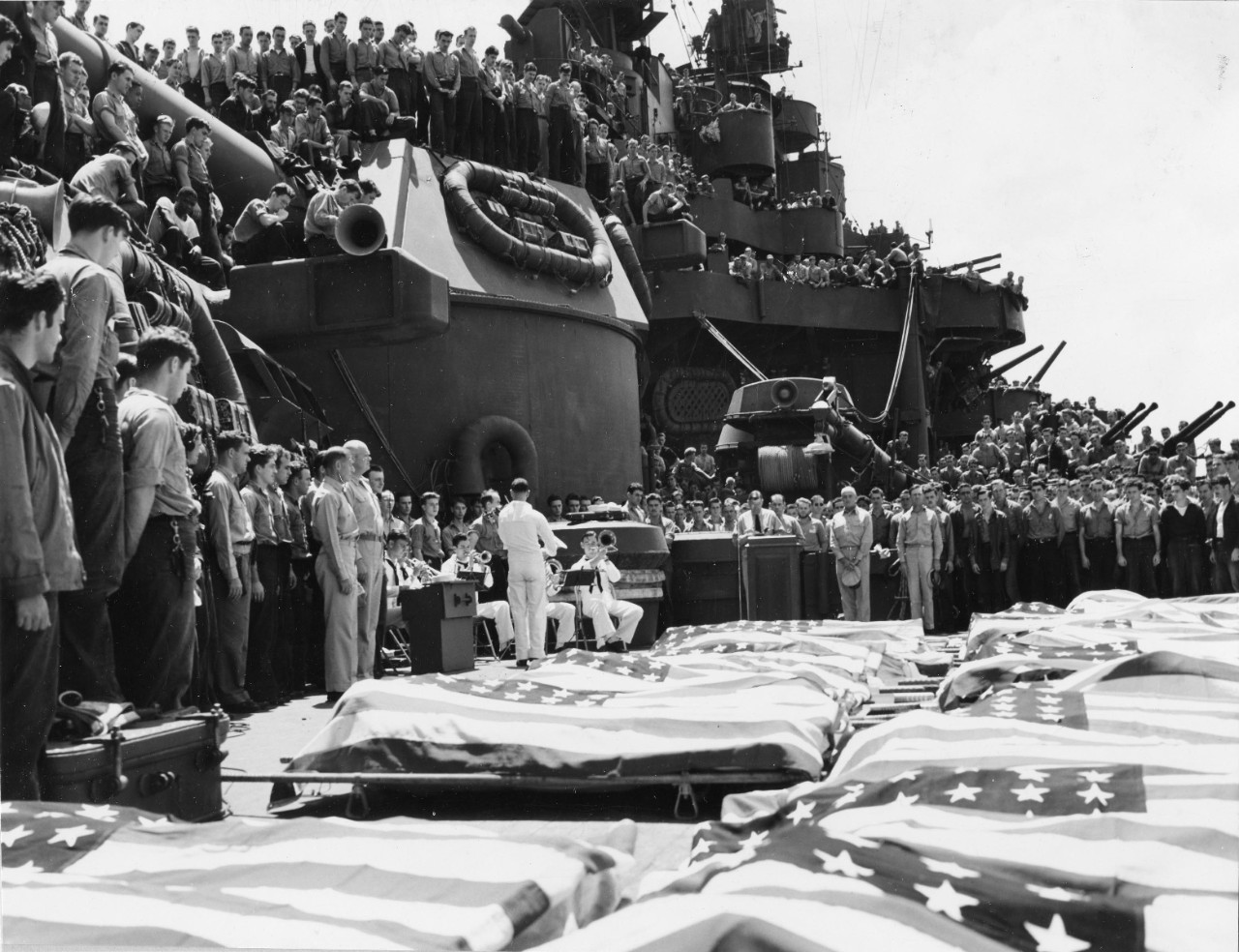
Robert grew up in Lebanon, Marion Co., IN where his parents continued to live most of their lives. His father, Robert Sr., was the local Fire Chief. The Selective Training and Service Act of 1940, enacted in September, required all men between 21 and 35 years of age to register. Robert registered on October 16, 1940 at age 27. He married Mary Lou Bowen, also of Lebanon, on August 30, 1941. Less than nine months later, Robert and Mary would be parted when he enlisted in the US Navy on May 4, 1942 in Indianapolis, IN. It is assumed that Robert elected to join the Navy before he was drafted into military service.
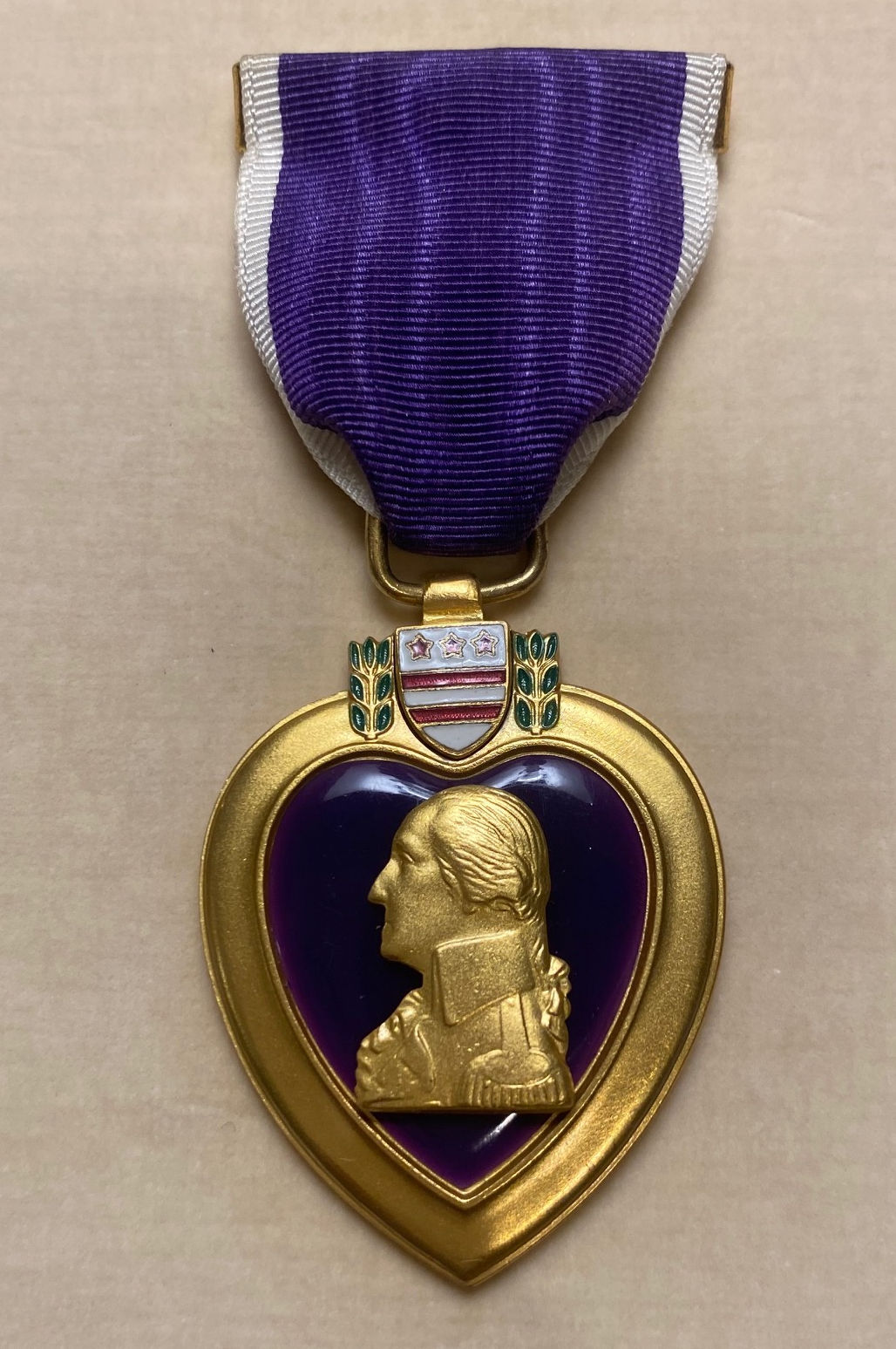
At enlistment, Robert was 2 months shy of his 29th birthday. He completed basic training at the Naval Training Station, Great Lakes, IL. He performed well and scored high on testing as evidenced by his rating as a RT2c (Radar Technician second class) at the end of training. On May 21, 1942, he was received at the Naval Training School (Radio Materiel), Chicago, IL. to continue his training in radar. He remained there until September 27, 1942, when he was transferred to San Francisco. Three days later he arrived at the Naval Training School (Radio Materiel), Treasure Island, San Francisco, CA, “for instruction.” He trained there for about six months. From San Francisco he was transferred on April 5, 1943, to the Receiving Station at Bremerton, WA, for forwarding for duty at the Naval Operating Base (NOB) at Kodiak, Alaska. He would remain there for one month. On May 15, 1943, he was transferred to the NOB, Dutch Harbor, Alaska for duty in the Advanced Communication Pool. He served there less than 2 months. His next stop was at NOB, Adak, Alaska where he arrived on August 6, 1943. Robert would serve in Adak for over one year. Ten months after he arrived, on June 30, 1944, he earned the rating of RT1c. On September 17, 1944, he was transferred to USS Kimberly DD-521. She was a Fletcher-class destroyer and had seen action in the Gilbert and Aleutian Islands before returning to San Francisco, CA in September 1944, where Robert would go aboard. This was his first duty on board a ship. He would have mingled with crew members who had lots of war stories to tell. But, before Kimberly departed for her return to the Pacific, Robert was transferred. On November 30, 1944, he went aboard USS Indianapolis CA-35 at Mare Island where she was being overhauled following almost 12 months of battle action across the Pacific. Robert was one of four radio technicians received on board that day. Transferring from a destroyer to a heavy cruiser must have been a bit overwhelming for Robert. There was no comparing the size of the two ships. Kimberly had a wartime complement of approximately 329 men and Indianapolis’ complement was over 1,200. Robert had a month to settle into life on board Indianapolis. She would spend Christmas and New Years in port in San Diego before departing on Jan 3, 1945, with TU 12.7.3 for Pearl Harbor. Admiral Raymond Spruance, commander of the 5th Fleet came back on board at Pearl Harbor. Indianapolis was his flag ship of the fleet. On February 14, 1945, Indianapolis joined Vice Adm. Mitscher’s fast carrier task force, just two days before it made the first attack on Tokyo. Robert’s skills would be tested during the intense battle action through March 1945. During the softening up of Okinawa, beginning March 25th, Indianapolis shot down six Japanese planes and assisted in destroying two more. The luck of Indianapolis changed on March 31, 1945 when a kamikaze plane approached the ship with little warning. Tracer shells from the ship crashed the plane but not before it struck a glancing blow to the port side of the after main deck causing little damage, but the bomb carried by the plane released, tore through the deck into the mess hall, berthing compartments below and down deeper into the fuel tanks and exiting the bottom of the ship where it exploded. Nine crew members were killed. There is no record that Robert was among the twenty men injured in this horrific event. Admiral Spruance disembarked Indianapolis after the attack and USS New Mexico became his flag ship of the 5th Fleet. When the admiral left, his flag allowance staff followed close behind and it now included Robert. Spruance surrounded himself with the most qualified men. On April 6, 1945, Robert was officially received for duty aboard New Mexico where he would serve for almost two months. USS New Mexico was the first built in her class and was commissioned in 1918. She was advanced for her time having been equipped with a turbo-electric drive which propelled the massive 32,000-ton battleship to a max speed of 21 knots. The realities of war had been made too real when the kamikaze plane struck Indianapolis. Robert now found himself on board New Mexico which had been damaged in Jan 1945 by a kamikaze attack during the invasion of Luzon. The plane hit the bridge killing the commanding officer and 29 crew members. He wondered what the odds were that his new ship would suffer a second attack. Pretty low, he likely thought. He was wrong. When Robert went aboard New Mexico she was still engaged in the invasion of Okinawa. Her fire support continued off and on until May 11th. She was approaching her berth in Hagushi anchorage on May 12th when two kamikaze planes made her their target. The first plane made a dive and was strafing the ship on its approach. The ship's guns trained on their target and a shell from one of the 5" guns burst beneath the plane and forced it off target. The plane did minimal damage with the strafing before plunging into the sea. The second plane took advantage of the distraction of the first plane and dove on the ship before she could train her guns in its direction. A direct hit was made "on the gun deck on the starboard 20mm tub and smashed into the forward stack. A.A. ammunition fell through the hole created by the plane and tumbled down into the boilers causing a massive explosion...". 54 crew members were killed, 3 missing and more than 100 wounded. Robert was one of the wounded, but no details are known.(Note1). The following day, a funeral service was conducted on board. A photo of this solemn service is shown below. Thirty minutes after the service began, the men returned to their battle stations when nearby ships reported possible enemy submarines in the area. New Mexico remained at Hagushi, off Okinawa, until May 28th when she departed for Leyte for repairs. Before departure, Robert was transferred off the ship. He had lived through Hell the past six weeks having the two ships he served in hit by enemy suicide planes. He feared he was walking on eggshells and his luck would run out. Robert was received on June 1, 1945, at CinCPAC (Commander In Chief, Pacific) Advanced Headquarters at Guam, the shore base for ADM Spruance and his flag allowance. Spruance had arrived there earlier from New Mexico and planned to remain to prepare for the invasion of Japan. Robert likely wished he could remain there and never return to sea. It was not to be. He remained on shore only two weeks. On June 14, 1945, Robert received orders to return stateside and report to the commanding officer of USS Indianapolis. Because of his injury on board New Mexico, he was granted a 30-day rehabilitation leave before reporting to his assignment. This leave period of absence was granted to sailors returning from intense, prolonged combat zones or strenuous duty in the Pacific Theater. It was designed to provide respite, allowing personnel to recover from combat fatigue, stress, or minor injuries before reassignment. This meant he now had 30 days from June 14th before reporting aboard Indianapolis. Unfortunately for Robert, the time it took to return stateside counted as part of his 30 days. He left Guam and arrived June 16, 1945 at Pearl Harbor where he remained for four days before being transported to CA. It is assumed Robert enjoyed the remainder of his leave in CA. He reported to the receiving station in San Francisco, CA on July 14, 1945, and was transferred to Mare Island Navy Yard, Vallejo, CA, that same day and went aboard Indianapolis. It is most certain that Robert was ordered back on board Indianapolis because he was a RT1c, first class Petty Officer, and was needed to fill the billet. Many Indy crew members were transferred off the ship while she was at Mare Island, CA, for repairs. The remaining RT's on board were 3rd class and Robert would help with their training and supervise their work. Only one day after Robert reported aboard, Indianapolis would depart Mare Island. One can only imagine how terrifying the thought of returning to sea was for him. On Sunday morning, July 15, 1945, Capt. Charles B. McVay, III, received orders that he was to depart that day for Hunter's Point Navy Yard in San Francisco Bay where he would receive top-secret cargo for transport to the island of Tinian in the Northern Mariana Islands. Two Navy officers would come aboard with the cargo to ensure its safe delivery. He was not told the contents of the cargo, only that he was to proceed at flank speed to Pearl Harbor, refuel and continue on. In the early morning hours of July 16, 1945, Indianapolis prepared to get underway. She departed Hunter's Point at 8:00 a.m., and at 8:36 a.m., passed under the Golden Gate Bridge. Arriving at Pearl Harbor, Robert would long for just a few hours on dry land. It was not to be. No one without a previous order was allowed to go ashore. But, there was good news. Indy had steamed, averaging 29.5 knots, over 2,000 nautical miles in 74.5 hours from the Farallon lightship at San Francisco to Diamond Head, Oahu, TH, setting a new time record. The crew erupted with shouts and cheers when Capt. McVay announced the speed record. Indy refueled and continued her mission. She unloaded her top-secret cargo at Tinian, Northern Mariana Islands, on July 26, 1945. She left that afternoon and arrived the next morning in Apra Harbor, Guam. Robert most likely thought his service on board Indianapolis would end at Guam. He was back where he had started a month earlier. Indeed, Robert was transferred off to the Commander of the 5th Fleet, Apra Harbor. He disembarked for shore duty. Any hope Robert had of staying on shore with his shipmates was dashed when he was ordered back on board “for temporary duty.” The other members of the flag allowance on board with Robert were LCDR Cedric Foster Coleman, commander of the flag allowance, Arno John Telford, RT3c, Ray Gunther Wenzel, RT3c and two new members who had arrived in Guam from basic training in the US and were waiting to come aboard, William Hearn Bradley, S2c (SM) and Pat Leon Adams, S2c. Robert’s temporary duty meant he would likely meet Spruance in the forward theater when he came back on board Indianapolis or Robert would transfer to another ship that Spruance selected as his flag ship and return to his normal flag allowance duties. Another possibility was that he would be sent to another shore headquarters to meet up with Spruance. The one possibility he never considered was not ever returning to the full flag allowance. Robert, LCDR Coleman, Telford, Wenzel, Adams and Bradley were lost at sea two days after leaving Guam when Indianapolis was torpedoed by Japanese submarine I-58 and sunk in less that 12 minutes. Richard Banks Redmayne, Lt(jg), Chief Engineer, a survivor, stated that he joined men on a life raft shortly after the sinking in the early morning hours of July 30th. Within three hours two more life rafts and two floater nets all joined together. Other survivors joined the group that night that eventually consisted of about 150 men. "Tuesday morning we buried one man by the name of Barker, radio technician first class, who was on Commander Fifth Fleet Staff." He gave no details of Barker's death. All six names are inscribed on the Tablets of the Missing in the Manila American Cemetery, Fort Bonifacio, Taguig, Philippines. All were awarded the Purple Heart, posthumously. Robert, you are not forgotten. At the time of Robert's death, his wife, Mary, was living in Los Angeles, CA.
Source Credits
Official USN records, Commander in Chief, Pacific Advance Headquarters Detachment, Commander Fifth Fleet, Flag Allowance 6/1/45 to 10/2/45; Muster Rolls and Report of Changes USS Indianapolis CA-35 USN Deck Logs, Muster Rolls and Report of Changes. Vincent, Lynn and Vladic, Sara (2018). Indianapolis. Simon & Shuster, New York. p. 116 The Indianapolis Star, Tues, Aug 14, 1945, page 18; citing Robert C. Barker, Jr. MIA The Indianapolis News, Fri, Aug 17, 1945, page 23 citing Robert C. Barker, Jr. MIA IN, Marion Co., US Marriage Index, 1925-2012, Ancestry.com; citing marriage of Robert Barker and Mary Bowen. Faram, Mark D., Chief of Naval Personnel Public Affairs (2021). "Midway, Momentum, and Manpower- The Navy's Bureau of Personnel in WWII." Online at navy.mil. War Diary, USS New Mexico, “Report of Okinawa Jima Operations,” Vol. 6.; citing list of injured in kamikaze attack 12 May 1945. USN, Naval History and Heritage Command, "A Kamikaze Attack on New Mexico, Fifth Fleet Flag: A Photo Essay". Online: https://www.history.navy.mil/browse-by-topic/wars-conflicts-and-operations/world-war-ii/1945/battle-of-okinawa/kamikaze-attack-new-mexico.html; photo of funeral service on board 13 May 1945.
Submit additional information, photos, or corrections for Robert BARKER.
Photos / Clippings / Other