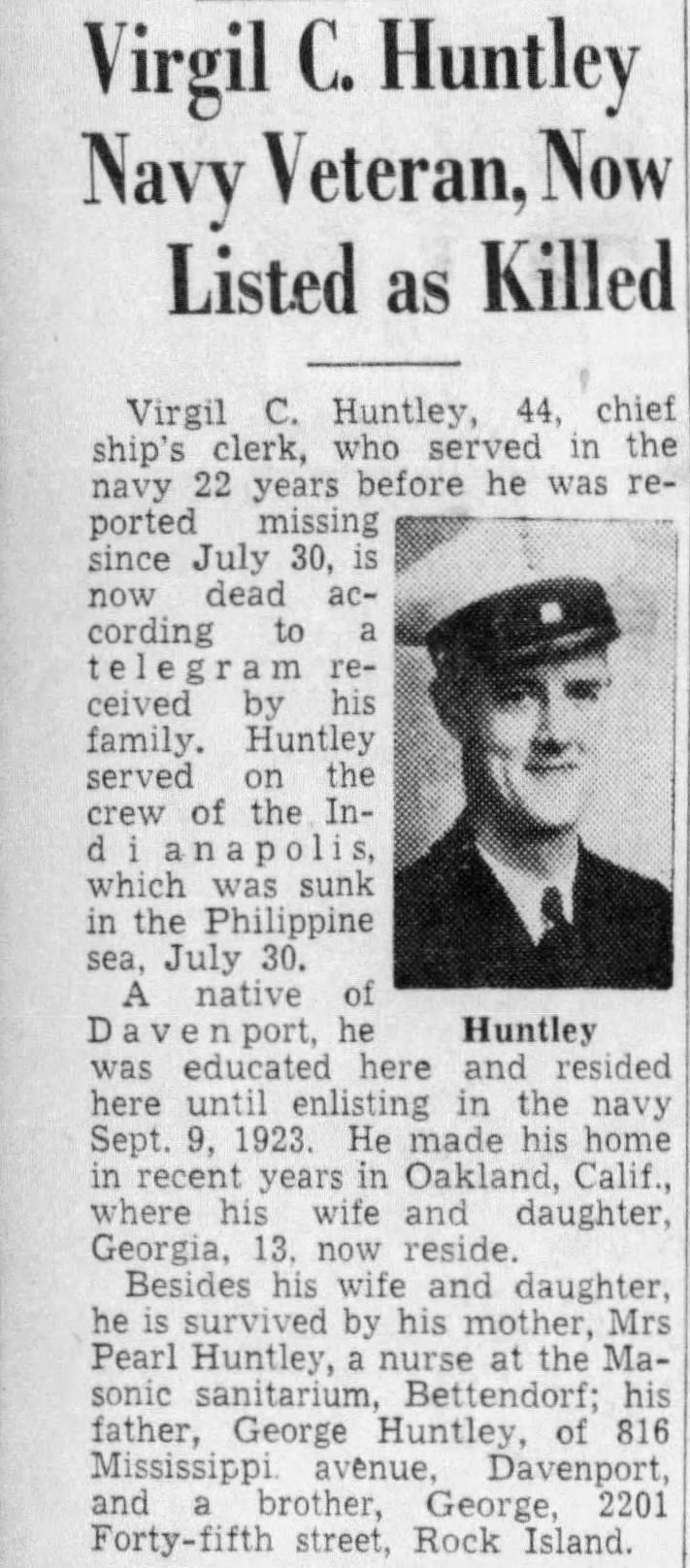
Virgil Clair Huntley was 40 years and almost 8 months old when he gave all to his country on July 30, 1945. He was one of the oldest crew on board USS Indianapolis CA-35 when she was sunk by Japanese submarine I-58. He had served in the US Navy for 21 years and 10 months at the time of his death.
His service included duty on board USS John D. Edwards DD-216, USS Roper DD-147, onshore at the Kansas City Recruiting Office, USS Decatur DD-341, USS Detroit CL-8, USS Aldebaran AF-10, onshore at the Federal Building in San Francisco and on USS Indianapolis CA-35.
Virgil was born Dec 9, 1904 in Viola, Mercer Co., Illinois, to George Edward and Mamie Pearl George Huntley. He had one brother, George Lucas, born Sept 21, 1902. The family moved to Davenport, Scott Co., Iowa before Virgil was six years old. According to his friend, Francis A. Zeman, he had known Virgil "since childhood as we started grade school together and finished high school together in Davenport, IA. After completing high school in 1923, Virgil joined the Navy, then the Davenport recruiting office and served consecutive enlistments until 1945."
By 1920, Virgil's parents were divorced, but his father continued to live in Davenport and worked as the conductor of a street car. He remarried in late 1920.
The 1920 census of Davenport recorded Pearl Huntley, age 37, head of household, with George L., age 17, and Virgil, age 15, in the home. Pearl was working in a department store, George L. was a "helper" in an optical store and Virgil was attending school.
Virgil enlisted in the US Navy on Sept 10, 1923 at Davenport agreeing to four years of service. He was 3 months shy of his 19th birthday.
The 1925 Iowa State census was enumerated May 1st. It showed Pearl, age 43 and widowed. George, son, was 22 years old and Virgil, son, was 20. They were living in the home of Pearl's mother, Jennie George, head of household, a widow, age 63.
Why Pearl was listed as a widow is unknown. Women often used this marital status rather than reveal they were separated or divorced which might reflect badly on their character. As noted above, Virgil had enlisted in the Navy on Sept 10, 1923. It can only be assumed that Virgil was listed in the household based upon the "usual place of abode" rule used by census takers when a person was away from the home temporarily. Military service was not considered a temporary absence, but Virgil's mother may not have understood the rule and simply listed him as living in the home. Regardless of the reason for the listing, there is little doubt that Virgil was not living in the home on May 1, 1925. (Note 1)
It is known with certainty that Virgil served on board at least two destroyers between early 1924 and early 1931. His first duty was in USS John D. Edwards DD-216, a Clemson-class, commissioned in 1920. Also, in USS Roper DD-147, a Wickes-class, recommissioned in March 1930 after being mothballed in 1922.
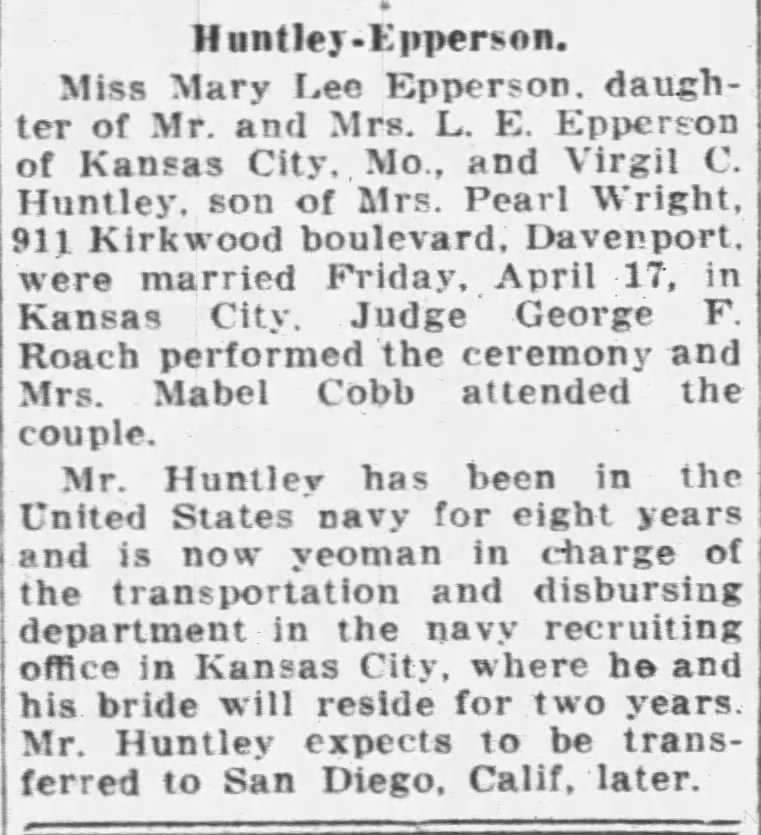
Virgil married Mary Lee Epperson, daughter of Mr and Mrs L. E. Epperson, of Kansas City, MO, on Fri, April 17, 1931, in Kansas City. The wedding announcement was published in the Rock Island, IL, newspaper and provided the location of Virgil's military assignment at that time. "Mr. Huntley has been in the US Navy for eight years and is now yeoman in charge of the transportation and disbursing department in the navy recruiting office in Kansas City where he and his bride will reside for two years. Mr. Huntley expects to be transferred to San Diego, CA, later." In addition, the announcement showed, "He was the son of Mrs. Pearl Wright, 911 Kirkwood Blvd., Davenport, IA (Note 2). A year after their marriage, Mary Lee gave birth to a beautiful baby girl they named Georgia Clarine.
Since his enlistment, Virgil had advanced from Apprentice Seaman, to Seaman 2nd class, Seaman 1st class, Yeoman 3rd class and at the time of his marriage he would have been at least a Yeoman 2nd class.
As stated in the marriage announcement, Virgil was indeed transferred to San Diego, but he would not travel alone to his new assignment. Mary Lee and little Georgia would be by his side and he settled his family into a home on Hamilton Street. Virgil re-enlisted in the Navy, for the third time, Sept 10, 1933, committing to four more years of service.
Virgil was ordered to service on board USS Decatur DD-341, a Clemson-class destroyer, and he likely went aboard in 1933. Logs from this ship are not available to the researcher, so how long he was on board is not known with certainty. Decatur served as the flagship for Destroyer Squadron 11, Pacific Battle Fleet, until 1937 when she transferred for service in the Atlantic theater. The Flag Allowance was a special select group of sailors who traveled with the Flag Commander of the Battle Force. Although records are not available to this researcher, there is little doubt that Virgil served in the Flag Allowance.
He is listed in the 1937 San Diego city directory as living on Monroe Avenue and serving in the US Navy.
The 1940 census was enumerated April 2nd and 3rd and shows Virgil, Mary Lee and Georgia, now 8 years old, living in Lemon Grove, San Diego Co., CA. Virgil was 35 years old and a Yeoman 1st class on board USS Detroit in the Flag Allowance, ComDesBatFor (Commander Destroyer Battle Force). This census asked where the person was living on April 1, 1935 and Virgil stated he lived in the same location. Mary Lee was 29 years old, born in Missouri. She was a housewife.
It is most probable that Virgil transferred off Decatur in 1937 when she was reassigned to the Atlantic theater. From Decatur he was assigned to Detroit CL-8, a Omaha-class light cruiser and much larger than the destroyers in which Virgil had served. Her initial service was in the Atlantic until 1931 when she was reassigned to the Battle Force based out of San Diego. She conducted exercises along the west coast and maneuvers in Alaskan and Hawaiian waters. However, she remained mostly in the Pacific with the Battle Force and served as a flagship.
According to the above census record of April 1940, Virgil was a Y1c by this date. The date he was advanced to Y1c is not known, but it was likely at least 6 years earlier, in 1934, or may have been at his re-enlistment on Sept 10, 1933. The Navy required a certain length of service before being advanced to the next rating.
Virgil was transferred off USS Detroit at Pearl Harbor. He was received on board USS Memphis Aug 30, 1940 as a passenger for transport to San Diego, for discharge. Eight days later, Memphis arrived at San Diego and no doubt Virgil rushed home to see Mary Lee and Georgia. He was honorably discharged Sept 27, 1940 and re-enlisted the next day, for the fourth time, for four full years. He was "reissued his acting appointment as CY."
The above is proof that by Sept 27, 1940, Virgil had been advanced from Y1c to CY(AA) - Chief Yeoman, Acting Appointment. Again, this reenforces that he likely served as a Y1c for 6-7 years before his advancement to CY. It had taken him 17 years to advance from an Apprentice Seaman to a Chief Yeoman.
A Chief Yeoman was a Chief Petty Officer, the highest rating of an enlisted man. He was an administrative specialist critical to naval administration. Just a few of his clerical duties included maintaining, or supervising the maintaining of, personnel records including officers and the command, handling critical reports and correspondence, and managing office personnel. In short, any administrative clerical duty that required expertise fell to the CY.
Where Virgil served from late Sept to late Dec, 1940 is not known.
On Christmas Day, Dec 25, 1940, Virgil was transferred from San Diego to San Francisco, CA. He, Mary Lee and Georgia packed up their belongings and began the 500 mile trip to their new home.
Virgil thought his days on board a ship might be over after leaving Pearl Harbor in Aug 1940, but the Navy had additional plans for him. At San Francisco, he was approved for a permanent position as CY (PA) (Chief Yeoman, Permanent Appointment). This was cause for celebration but there was little time. On Jan 14, 1941, he received orders to report aboard USS Aldebaran. Mary Lee and Georgia would have to adjust to life in a new city without Virgil. They went about everyday life knowing that Virgil would return home. They would wait for him, as they always did.
Aldebaran was an older vessel, launched in June 1939 as USS Stag Horn, a C-2 cargo ship. The Navy needed refrigerated vessels and looked for cargo ships that were already refrigerated and could be converted for their needs rather than constructing new vessels. The Navy had set a deadline for the acquisition but the Maritime Commission was unable to meet it with the requirements the Navy insisted upon. The Commission offered a non-refrigerated ship, SS Stag Horn, and the Navy accepted her on Dec 26, 1940 and placed her in commission in ordinary the same day. She was sent to the Moore Shipbuilding Co., Oakland, CA for conversion. However, "the following day the Commandant, 12th Naval District, informed the CNO that an urgent need had arisen for a ship to transport defense material to Samoa and suggested that ex-Stag Horn be used." (Roberts). Her conversion was put on hold. The Navy commissioned the new acquisition USS Aldebaran on Jan 14, 1941, the day Virgil was ordered to go aboard.
After the voyage to Samoa, the ship steamed to Hawaii on another mission before she returned to Oakland, CA. Aldebaran was converted to a AF (Provision Store Ship) from April to October 1941. (Roberts). Virgil remained on board during the conversion and afterwards. Apparently, during this time Mary Lee and Georgia made the short move from San Francisco to Oakland. Shortly before the start of the war, the Bay Bridge was completed that connected Oakland and San Francisco separating the two cities by only 15 or so miles.
No records were located showing the history of Aldebaran's service after the conversion was completed. However, a former officer, Ens. William C. Meyer, went aboard the same day as Virgil and after the war he submitted two photos of the ship's officers to Navsource.net. In addition, Meyer offered a very brief history of her service: "The Aldebaran was a supply ship operating between San Francisco and Pearl Harbor, carrying primarily food supplies to the Navy in Hawaii. Our Commanding Officer was Royal W. Abbott, USN, a 'by the book' disciplinarian..... In the summer* of 1941 we made one trip from San Francisco to Pago Pago, Samoa carrying construction material, 6-inch coastal defense guns and ammunition to fortify the island of Tutuila.(Note 3) This particular trip we ran Darken Ship due to a German raider reportedly roaming the Pacific. We left Pearl Harbor on 1 Dec 1941 and arrived back in San Francisco on the 6th, just missing the devastating attack on 7 Dec 1941. We immediately loaded the ship with ammunition, in lieu of food, since Pearl Harbor and the ships were virtually depleted of ammunition, and headed back to Pearl."
It can only be imagined how thankful and relieved Mary Lee was that Virgil was back home just one day before the bombing. Her feelings quickly changed to great fear as Virgil headed back to the devastated area. Would more attacks be made? How much danger would he be in? Would he ever return home? Mary Lee would live with this fear for the next 12 months as the US was now at war with Japan.
On Dec 14, 1942, after almost two years on board Aldebaran, and at age 37, Virgil was transferred to "ComTwelve for duty." He arrived the next day at the "Headquarters of District Staff, 12th Naval District, San Francisco, CA." Mary Lee and Georgia were so happy that Virgil was home and back on dry land. They were once again a family. For how long, they did not know, but life was good for now.
In documents, below, Virgil was said to have served at "the Federal Building in San Francisco." This most assuredly referred to the San Francisco Federal Building, located in the city's Civic Center complex, that served as the headquarters of the 12th Naval District staff during the war.
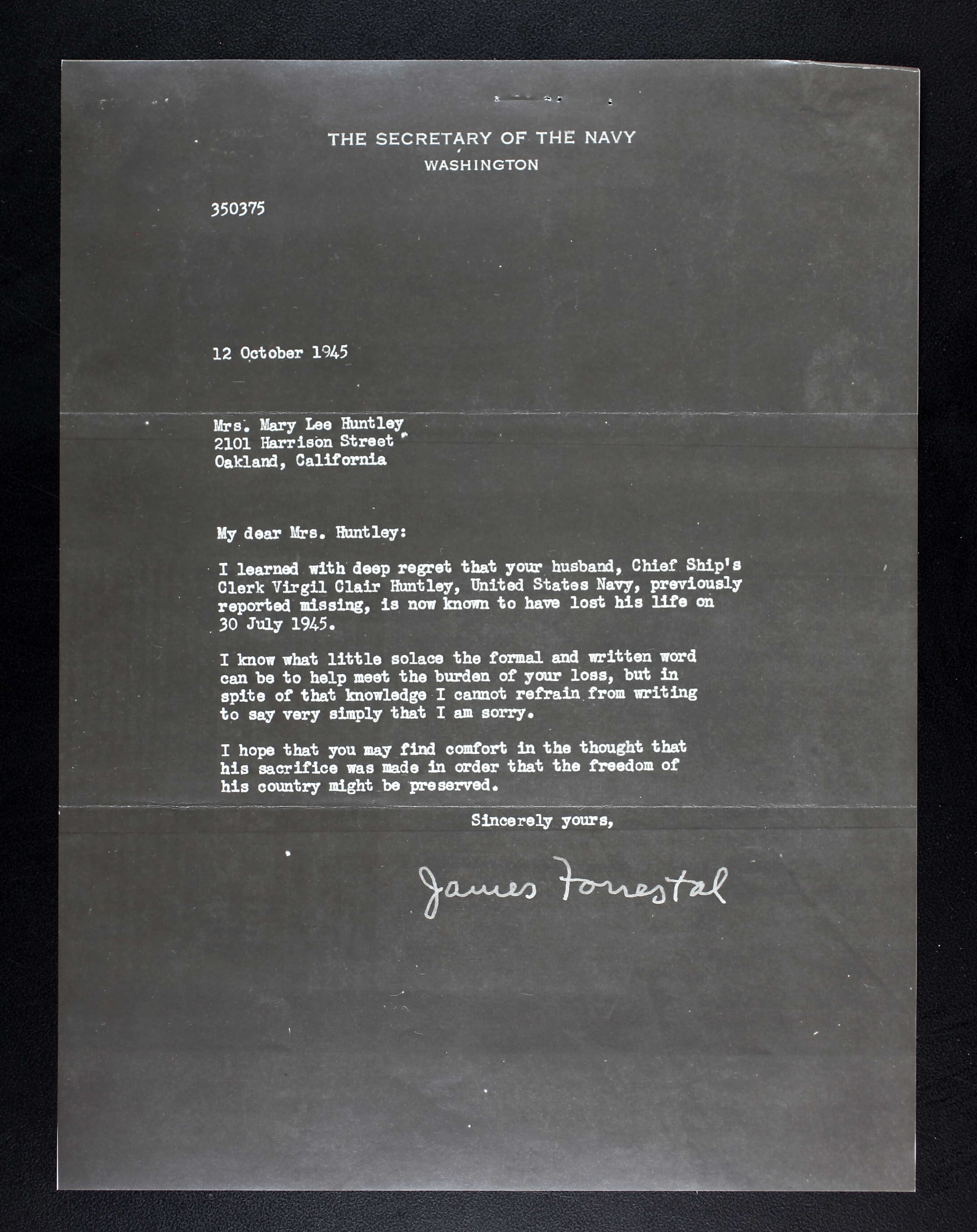
Virgil and Mary Lee continued to live in Oakland, CA, according to a letter written by his father, shown below. With the short distance to San Francisco and Virgil now having "office hours" he could return home every night. Georgia was now 10 years old and he knew she needed him in their home.
By mid-1942, with the war progressing, the Navy was faced with massive administrative tasks. To help alleviate the strain, Congress passed an Act on July 18, 1942, that established a new naval Warrant Officer rank - Ship's Clerk and Chief Ship's Clerk.
This was a highly skilled specialist position that evolved from the yeoman duties and was considered a crucial administrative function. It involved handling personnel records ensuring records and men flowed smoothly on ships, mail, correspondence, and legal matters, often working under the Executive Officer.
A Ship's Clerk would receive a commission (warrant) signed by the Secretary of the Navy. Only Chief Petty Officers were considered for advancement to Warrant Officer.
Virgil had been in the Navy for 19 years and had his eye on this new rank with a dream to reach the top rank of Warrant Officer - Chief Ship's Clerk. Moving from an enlisted rating to officer rank was an accomplishment few enlisted men would realize. Virgil was an example of the enlisted man the Navy had in mind when the Act was written. Throughout his 19 year rise through the rates and ratings, Virgil had gained vast experience on shore and at sea and with his formal training was now considered an expert and more than capable of handling all duties of a Warrant Officer. His expertise would be invaluable to both enlisted and officers.
Sixteen months later, on Jan 27, 1944, while still serving at the 12th Naval District staff office, Virgil's first dream came true when he was appointed Warrant Officer, Ship's Clerk, USN. After 20 years in service, he would now don an officer's uniform every morning. The blue uniform from his Chief Petty Officer's days would be pushed to the back of his closet.
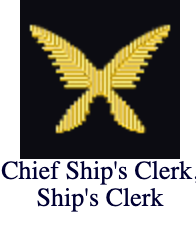
How smart he must have looked to Mary Lee and Georgia. The corps device of two gold crossed quill pens was displayed above a thin gold stripe with blue breaks around both cuffs of his double-breasted service coat. His cap was embroidered with two gold crossed fouled anchors and had a thin gold chinstrap.
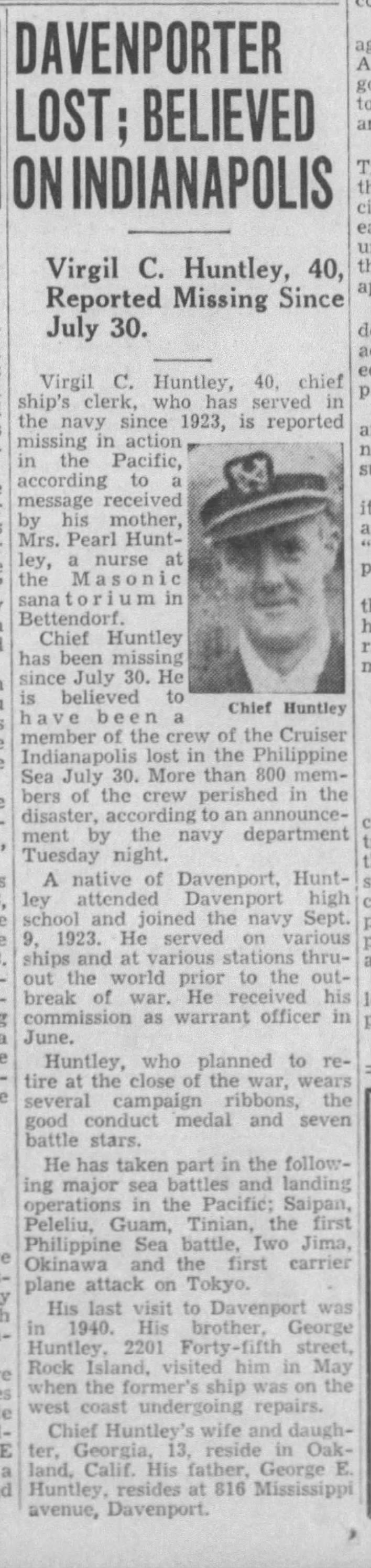
The photo of Virgil in the upper right corner was taken after his appointment to Warrant Officer as evidenced by the cap he is wearing.
The day Mary Lee dreaded arrived about two months after Virgil's appointment. He was ordered back to sea. Virgil was to report to the Commanding Officer of the famed USS Indianapolis CA-35.
After a very tearful goodbye, Virgil boarded a transport ship bound for Pearl Harbor to meet his new assignment. As he stood on the dock he was in awe of his new ship. She was similar in size to the Omaha-class light cruiser, USS Detroit (CL-8), he served in over two years, but not as majestic. Detroit carried 12 6" guns and Indy's 3 triple mount 8" guns loomed from the deck. The destroyers he had served in had a compliment of only about 350. Detroit carried more men than a destroyer, but hundreds fewer than Indianapolis' compliment of 1,296.
Virgil knew he had a lot of work ahead of him. His eyes continued to scan the ship as he walked the gangway. He was granted permission to come aboard and he stepped onto the quarterdeck on April 14, 1944.
Virgil was too familiar with how the Navy operated and was not surprised to find that the ship he had finally caught up with at Pearl Harbor would remain in port only two days before returning to the San Francisco. Indy had arrived at Pearl Harbor from Majuro Atoll where she had taken aboard one injured Japanese POW and six additional POW's for confinement and transport. In addition, she had received 16 officers and 172 enlisted passengers and 300 sacks of US Mail. Virgil did not think the work load could get any worse, but he was wrong. Eleven Indy crewmembers were to be discharged from the Navy for "ineptitude." Virgil would handle and supervise the handling of a lot of paperwork for all these men. Then, it started again.
A large number of passengers came aboard for transport to San Francisco. At least he would have five days at sea to complete all the necessary paperwork for the men to disembark on April 21st.
With only eight days in port, he rushed home to see Mary Lee and Georgia. He cherished every moment, knowing it might be a long time before he would see them again.
After Indianapolis' short overhaul, 148 enlisted passengers boarded on the morning of April 29th and 413 more arrived the following day. Indy departed San Francisco on May 1st and arrived at Pearl Harbor on the 6th. Virgil thought the organized chaos had ended. It had not. The next day, 150 new crewmembers reported aboard for duty.
The ship would spend the next four days at sea conducting training exercises before returning to Pearl Harbor. Indy remained in port for the next two weeks, so Virgil had some extra time for himself and his support staff. He would be thankful for the time because when Indy left port on May 26th she was headed back to the war zone. As the flagship, she would serve in the Pacific 5th Fleet (formerly the Central Pacific Force) under the command of Admiral Raymond Spruance, who came aboard the day before departure.
This would be a period of brutal service for Virgil. From June to Oct 4, 1944, Indy took part in the capture and occupation of Saipan, Battle of the Philippine Sea, the capture and occupation of Guam, the capture and occupation of Tinian in the Northern Marianas Islands and on to the Western Caroline Islands operation for the capture and occupation of southern Palau Islands. Time in any port was short and mainly for resupplying stores and ammunition.
Indy arrived at Pearl Harbor on Oct 14, 1944 and departed the same day for Mare Island, CA, where she arrived on Oct 19, 1944. She would undergo an overhaul and a major refitting. For the work to be completed, most of the crew was removed from the ship. Many enlisted crew were granted leave or sent to training schools. Officers were granted leave on a rotating schedule. Enlisted men who remained were moved to barracks in the navy yard.
It is unknown if Mary Lee and Georgia came from Oakland to Mare Island to be with Virgil for the six weeks he was there. Officer's housing for married men was available in the navy yard. With Oakland being only about 25 miles from Mare Island, Virgil may have taken the bus back and forth every day. The important fact is that Virgil was able to be home with Mary Lee and Georgia when he was not on duty.
Thanksgiving was a special time for the ship. On Nov 17, 1944, Captain Charles Butler McVay, III, had assumed command of Indianapolis.
Indy left the dock at Mare Island on Dec 9th, steamed that same day for San Francisco Bay and would remain along the CA coast for the next four weeks undergoing trials, exercises and drills. Capt. McVay would assure that his ship and crew were ready for sea duty.
On the 14th, she departed for San Diego where she reported to the San Diego Shakedown Group. She got underway with the group on the 16th and conducted training exercises off the coast. However, engine problems forced her back to port for "emergency repairs" which took four days. Mary Lee and Georgia would not complain about this unexpected time with Virgil.
Indy's training would continue until after the first of the year. However, she returned to port in San Diego for Christmas and New Year's Eve and Day where Virgil would once again be with his family. But, their time together was coming to an end.
On Jan 3, 1945, Indy departed San Diego with TU 12.7.3 for Pearl Harbor. For Virgil, the departure was complicated when 12 men failed to report back to the ship from shore leave. This caused unanticipated clerical duties for him to oversee.
Arriving at Pearl Harbor on Jan 9th, Indy would remain for the next five days. On Jan 20th, Adm. Spruance, along with 112 Flag Allowance crew members, came back aboard.
Indianapolis arrived at Ulithi Lagoon on Jan 26, 1945 and would remain until Jan 31st. She joined Vice Adm. Mitscher's fast carrier task force on Feb 14th, two days before it made its first attack on Tokyo. Throughout the action, Indianapolis played her vital role of support ship.
She sailed on to Iwo Jima where action began on Feb 19th. Indianapolis did her share of the bombardment of the island. She moved back to Tokyo to Honshu and Nansei Shoto for more bombardment of the islands and remained until the operation ended on March 1st. She returned to Ulithi Lagoon.
On March 14, Indy was underway to joinTask Group 58.3.
The pre-invasion bombardment of Okinawa began March 24th and for 7 days Indianapolis trained her 8-inch guns and bombarded beach defenses. Enemy aircraft filled the sky attacking the ships. Indy shot down six planes and assisted in splashing two others. However, it was on the 7th day, March 31st, that Indianapolis was hit by a Japanese kamikaze plane. The plane struck a glancing blow to the port side of the after main deck causing little damage, but the bomb carried by the plane released, plummeted through the ship and exploded in the water beneath the hull. Nine crew members were killed. Twenty men were injured but Virgil was not among them.
Indy limped back to Mare Island, CA, for repairs and refitting, where she would remain for two-and-a-half months. Mary Lee and Georgia were waiting when Virgil returned on May 2nd.
For the next two-and-a-half months Virgil held his family close. He had been reminded that he could have been one of the crewmembers who did not return to Mare Island. Georgia was now almost 13 years old and seemed to be growing before his very eyes.
In late May, Virgil arrived home with news for Mary Lee and Georgia. On June 1, 1945, he would be commissioned Chief Warrant Officer - Chief Ship's Clerk. He had reached the pinnacle of his Navy career after 21 years of service. He was 40 years and 6 months old.
It is likely a ceremony was held on board Indianapolis, conducted by the Commanding Officer, attended by the officers and crew members. Virgil's Promotion Warrant would be read, a new insignia placed on his uniform and the oath of office would be administered. He would be presented with his warrant, printed on beautiful parchment paper and signed by the President of the United States.
We are left to image Virgil's new uniform. The corps device of two gold crossed quill pens was displayed above a wide gold stripe with blue breaks around both cuffs of his double-breasted service coat. His cap was embroidered with two gold crossed fouled anchors behind a shield with an eagle rising from the top and a wide gold chinstrap.
His garrison cap was adorned with a silver corps device on the right side and a miniature cap device on the left side. It would be worn with his work uniform.
No doubt that Mary Lee and Georgia were never so proud of Virgil. His uniform represented all that he had sacrificed and devoted to the Navy and his country, as well as Mary Lee's dedication to and support of him.
Normal life soon resumed. Virgil went aboard the ship every day and returned home in the evening. Georgia waited anxiously for July 4th. An open-house would be held on board the ship to give families and friends a change to see the inside of the ship. Most had admired her only from the dock On the big day, Virgil showed Georgia where he slept, ate his meals, the ice cream station and his office. They enjoyed cake and punch and small souvenirs and balloons were presented to all the children. Georgia and Mary Lee would not forget this day. They could now close their eyes and see where Virgil was when on board.
Indianapolis was expected to remain at Mare Island until at least late August. However, Virgil's happy life came to an end when he was informed the ship would depart Mare Island in four days - July 16, 1945. Virgil prepared to handle all the administrative duties necessary when the crew reported back on board. Men on leave and at service schools were sent telegrams ordering them back to the ship immediately. Workers from the navy yard were still on board completing repairs and some would remain on board the ship when she departed. The chaos was made worse when passengers were due to arrive for transport.
Captain McVay received orders on Sunday morning, July 15th, to depart Mare Island that day for Hunter's Point Navy Yard in San Francisco Bay where he would receive top-secret cargo for transport to the island of Tinian in the Northern Mariana Islands. Two Navy officers would come aboard with the cargo to ensure its safe delivery. He was to depart Hunter's Point Monday morning and proceed at flank speed to Pearl Harbor, disembark passengers and the repair crew, refuel and continue on.
Virgil was not to inform Mary Lee and Georgia when the ship would depart. They probably knew by the look on his face that it would be soon. With broken hearts they wondered how long he would be gone. They would wait patiently for his return. He always returned.
When the ship departed Hunter's Point on July 16th, no one on board knew they were transporting the components of the atomic bomb that would later be dropped on Hiroshima. Virgil could never have imagined that his ship's mission would be a part of bringing the war to an end.
After delivering the cargo to Tinian on July 26th, Indianapolis steamed 1,300 miles, to Apra Harbor Guam, arriving the next morning. She steamed from Guam on the morning of July 27th en route to her final destination - Leyte in the central Philippines.
On July 30, 1945, half-way to Leyte and shortly after midnight, Indianapolis was struck by two torpedoes from Japanese submarine I-58 and sank in 12 minutes. Whether Virgil made it off the ship and into the water is not known.
At home, Mary Lee and Georgia went about their normal lives as they waited for Virgil to return. She had. no doubt he would until the first telegram arrived about the second week in August 1945. The news could not be true. Virgil could not be missing in action. There must be a mistake.
The next few weeks would be sheer agony for Mary Lee and Georgia. They were desperate for more news. Surely, with so much time having passed since the first telegram it meant that Virgil had been found. He had not.
The second telegram was devastating. "I deeply regret to inform you..... No hope of his survival." Words typed, cut and pasted to form the Navy's standardized language. The chilling words brought a cold finality to her world. The small yellow sheet of paper now defined a home without a husband and father. There would never be another day so dark or tragic as this. She would have to tell Georgia the news.
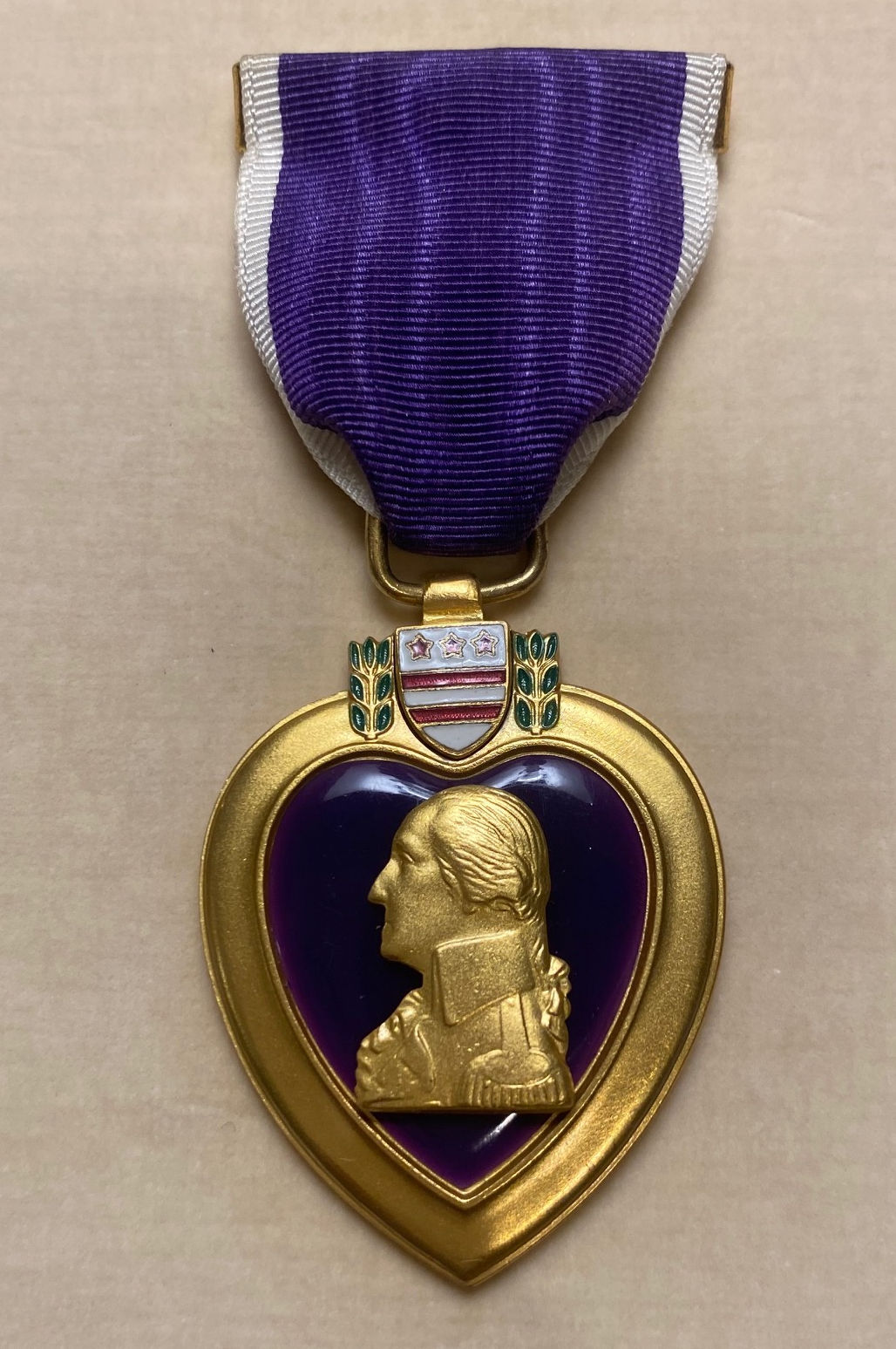
A few weeks later, Mary Lee received a package in the mail. Inside was a satin lined flip-top box containing a Purple Heart with Virgil's name and rank engraved on the back. Also inside was a personalized, embossed condolence letter signed by the President of the United States.
In addition to the campaign ribbons, service ribbons and individual decorations awarded to Virgil prior to his service in Indianapolis, Virgil was awarded one silver star, representing 5 bronze star devices, to place on his Asiatic-Pacific ribbon representing the five battle stars awarded to Indianapolis while he was on board.
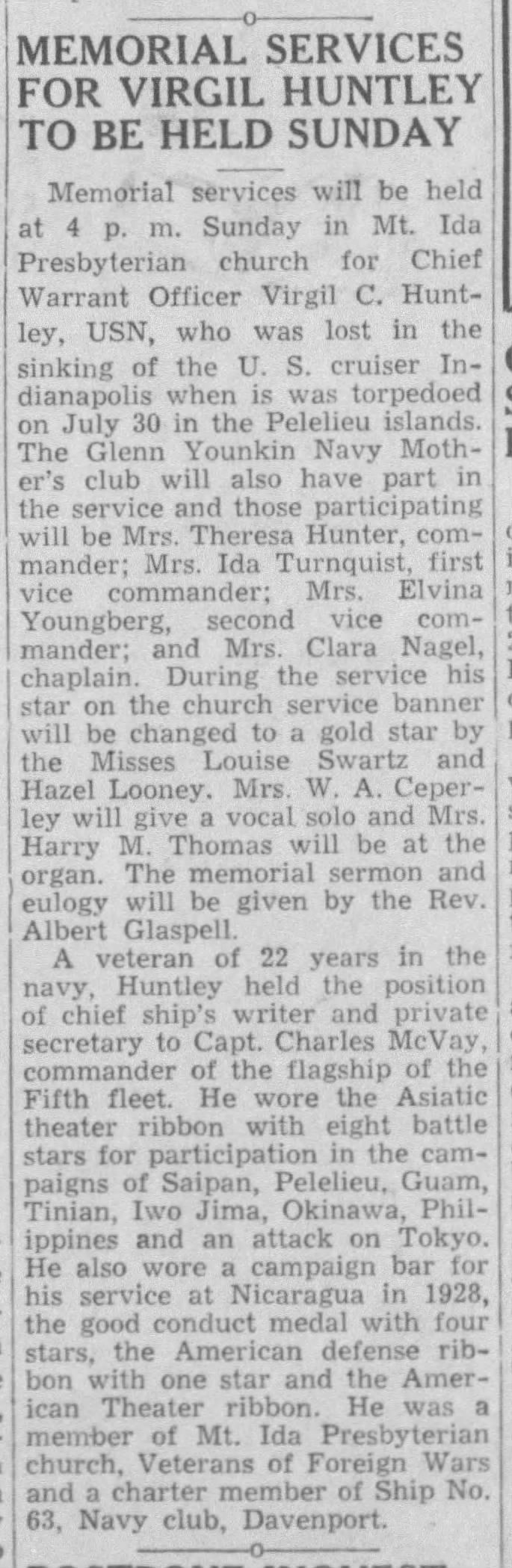
His name is inscribed on the Tablets of the Missing in the Manila American Cemetery, Fort Bonifacio, Taguig, Philippines.
A true patriot was lost to us. Virgil, you are not forgotten. Well Done.
A beautiful granite headstone was erected in the Aledo Cemetery, Aledo, IL. The top section of the stone is a cenotaph to Virgil and the bottom is inscribed with his mother's name and marks her grave. She died in 1953.
Mary Lee Epperson Huntley remarried on 23 Apr 1950, to Henry E. DeZeeuw, a WWII veteran. She died in 1995, age 84. She is buried with Henry in Riverside National Cemetery, Riverside, Riverside Co., CA.
Georgia Clarine Huntley Christensen died Dec 1, 1972 in Kern Co., CA. at age 41. The cause is unknown.
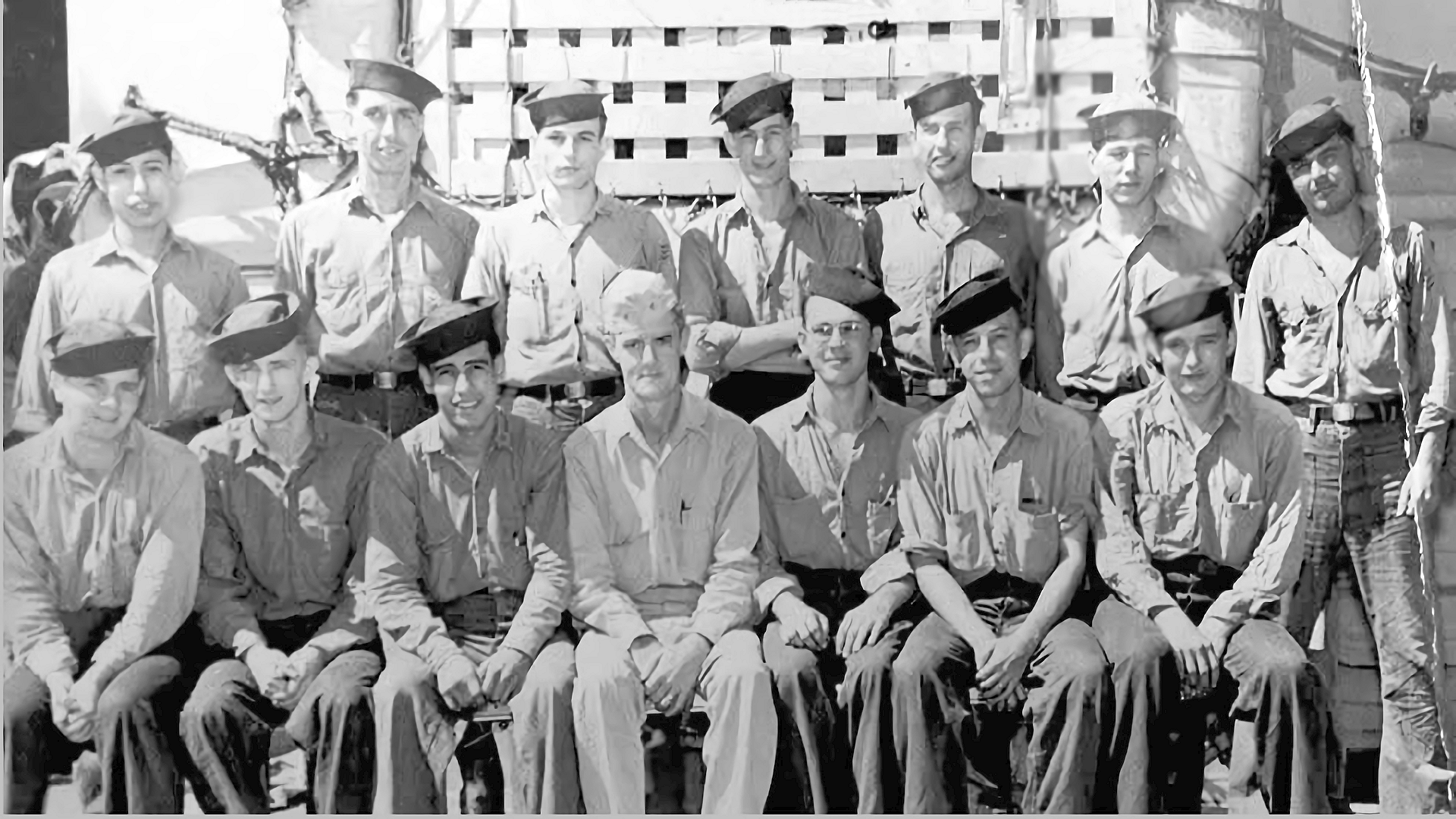
The photo, below, shows Virgil with his Indy crew members of the Administrative Division. This photo was taken between April 14, 1944 and June 1, 1945 before his promotion to CWO. He is in the front row, center, and wearing a Warrant Officer's garrison cap with corps devices of equal size, on both sides, near the front, in keeping with Navy uniform regulations.
Additional History
On 10 Oct 1949, Mary Lee Huntley of El Cajon, CA, filed a WWII Service Compensation Application, #307807, to the Service Compensation Board in Des Moines, IA, to claim a $500.00 widow's benefit offered by the state of Iowa.
There are 47 items, some duplicates, in the application folder and provides invaluable information about the USN service of Virgil Clair Huntley.
She signed a sworn affidavit on Sept 13, 1949, showing:
Widow: Mary Lee Huntley, 38 years old, of El Cajon, CA
Child: Georgia C. Huntley, 17 years old, of El Cajon, CA
Mother: Pearl Huntley, 66 years old, of Masonic Sanitarium, Bettendorf, Iowa.
Father: George E. Huntley, 70 years old, of Davenport, Iowa.
A certified copy of the marriage license of Mary Lee and Virgil proved the marriage date of April 17, 1931, in Jackson Co., MO.
After reviewing Mary's application and required supporting documents, there was a question as to her eligibility for compensation. The state of Iowa required that the serviceman be a legal resident of the state as of September 16, 1940 and for at least six months immediately prior to this date.
The board requested Virgil's service record from the US Navy that would show his legal residence while in service. The Navy Enlisted Services and Records Division responded with a letter showing:
9 Dec 1904 - Born at Viola, Illinois
10 Sep 1923 - Enlisted in the US Navy as a AS (Apprentice Seaman) at NRS (Naval Receiving Station), Des Moines, Iowa for 4 years. Address: Davenport, Iowa
10 Sep 1923 (date is an error and should read 10 Sep 1927) - Extended enlistment for 2 years
9 Sep 1929 - Discharged with an Honorable Discharge as Y1 at San Diego
10 Sep 1929 - Reenlisted in US Navy as Y1 at San Diego, CA for 4 years. Address: Davenport, Iowa.
9 Sep 1933 - Discharged with an Honorable Discharge as Y1 at San Diego, CA
10 Sep 1933 - Reenlisted in US Navy as Y1 at San Diego, CA for 4 years. Address: San Diego, CA
10 Sep 1937 - Extended enlistment for 3 years
27 Sep 1940 - Discharged with an Honorable Discharge as CY(AA) at San Diego, CA
28 Sep 1940 - Reenlisted in US Navy as Y1 at San Diego, CA for 4 years. Address: Lemon Grove, CA
15 Jan 1944 - Appointed Ship's Clerk (T), USN.
The board sent a letter to Mary L. Huntley, dated Oct 24, 1951, addressed to 215 El Cajon Blvd., Cajon, CA. It was returned with "Moved, left no address". On the same date, the same letter was mailed to Virgil's father, George E. Huntley, 816 Mississippi Ave., Davenport, IA. The letter was written in an attempt to clarify Virgil's legal address.
The letter stated:
Virgil was about 19 yo when he entered service, Sept 10, 1923, and served continually until his death on July 30, 1945.
His address when he married on April 17, 1931 was given as Jackson Co., MO.
Transcript of his service record showed his home address at the date of his entry into the Navy, September 10, 1923, to have been 110 East Hayes Street, Davenport, Iowa. The same address is stated at the date of reenlistment, Sept 10, 1929. Thereafter, on Sept 10, 1933 at reenlistment he gave his home address as 3979 Hamilton St., San Diego, CA and again Sept 28, 1940, at reenlistment, he stated his home address to be 366 Ave., Lemon Grove, CA.
The board contended that they could not determine if Virgil intended "to change his legal address from Davenport, IO to San Diego or Lemon Grove, or other place, or whether the addresses stated at San Diego and Lemon Grove were merely for convenience and the place at which his wife happened to be and would receive mail."
Virgil's father responded to the letter and stated:
"The addresses of Virgil Clair Huntley contained in the letter I received are correct. From the Lemon Grove address CA, he was transferred to the Port Directors office in San Francisco, CA, his permanent home address being in Oakland, CA, first at 2101 Harrison St, Oakland, CA, later moving to 5850 Birch Court, Oakland, CA which was the permanent address of he and his family at the time of his death. He evidently did not give notice of the change of address from Lemon Grove, CA to the Oakland, CA address."
On Dec 11, 1951, Mary's claim was denied. It was the board's opinion that Virgil "relinquished or abandoned legal residence in the state of Iowa some years prior to his entry into service, and such being the case, cannot be considered to have been a legal resident of Iowa as of September 16, 1940 and for at least six months immediately prior thereto which is one of the conditions of eligibility for World War II Service Compensation."
It seems a sad ending to the story. Not all states offered a "Veteran Bonus" program, but those that did set their own guidelines.
Mary applied for compensation in CA, but was granted only $200 for her daughter's educational expenses.
From Karen Washburn, granddaughter of Virgil and Mary Lee Huntley. In an undated facebook posting, she shared the following:
"The tragedy of the Indy and her crew changed the lives of everyone involved. My grandfather, Virgil C. Huntley, was not a survivor. My grandmother mourned him for 50 years. His dress uniforms hung in her closet, as if he would return any day. I grew up hearing their love story and I’ve carried him with me my entire life."
Karen was the daughter of a child of Virgil C. Huntley and throughout Karen’s lifetime she grew up in her family learning about (and also mourning) the loss of a grandfather.
Yes, the tragedy of the Indy and her crew changed the lives of everyone involved!
Source CreditsNote 1 - Virgil and his brother, George L., inherited $100 each from their great-grandfather, T. S. McKee, in 1910. Their mother, Mamie Pearl Huntley, was appointed their legal guardian until they reached the age of majority. Virgil's majority was not reached until Dec 9, 1925 and may be another reason why his mother felt the need to list him as part of the household in 1925 even though he was not living there. This is speculation only.
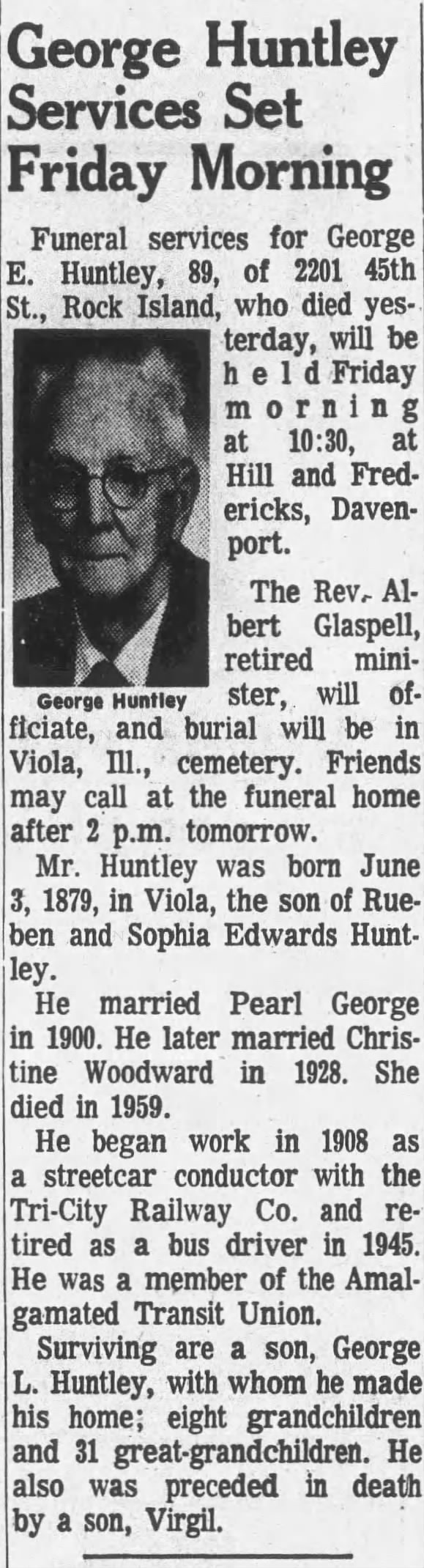
According to his obituary, George E. Huntley, (Virgil's father) remarried in 1928.
Note 2 - Virgil's mother is noted as "Pearl Wright". She may have remarried by April 17, 1931 or the name may be in error.
Note 3 - * Aldebaran's conversion was not completed until Oct 1941, so "summer" may be an error.
1920 US Census, Iowa, Scott Co., Davenport. Ward 6. Enumerated Jan 5, 1920; HH # 79; citing Pearl Huntley, Head of Household, sons George L. and Virgil C.
1925 Iowa State Census, Scott Cop., Davenport Ward 4, East Haynes; citing HH of Jennie George.
State of Iowa, Scott Co., District Court, Probate Records, Guardianship and Account Records, Case # 7145, In the Matter of George L. and Virgil C. Huntley.
1940 US Census, CA, San Diego Co., El Cajon township, Lemon Grove. HH# 366; citing Virgil C. "Huntly" family.
The Rock Island Argus, (IL), Wed, May 14, 1969, p. 5; citing death of George E. Huntley, father of George L., and the late Virgil Huntley.
The Rock Island Argus, (IL), Sat, Apr 24, 1931, p. 8; citing marriage of Virgil C. Huntley, son of Mrs. Pearl Wright, of Davenport, and Mary Lee Epperson of Kansas City, MO.
Roberts, Stephen S., 2000, Shipscribe; USS Aldebaran AF-10.
https://www.shipscribe.com/usnaux/AF/AF10.html
US Dept of Transportation, MARAD (Maritime Administration); Aldebaran AF-10
https://vesselhistory.marad.dot.gov/ShipHistory/Detail/124
Navsource.net. USS Aldebaran AF-10. https://www.navsource.net/archives/09/06/0610.htm
NavPers #15,018, Register of Commissioned and Warrant Officers of the United States Navy and Marine Corps, July 1, 1944; Gov. Printing Office, Washington. Chapter: Ship's Clerk; p. 564; citing Virgil Clair Huntley, Jan 15, 1944, Ship's Clerk.
NavPers #15,018, Register of Commissioned and Warrant Officers of the United States Navy and Marine Corps, July 1, 1945; Gov. Printing Office, Washington. Chapter: Chief Ship's Clerk; p. 462; citing Virgil Clair Huntley, June 1, 1945, Chief Ship's Clerk.
USN WWII Muster Rolls, 1938-1949; Ancestry database
USN Ships, Stations and Other Naval Activities, 1939-1949; Ancestry database
USN USS Indianapolis CA-35 Final Sailing List, 17 Aug 1945; Ancestry database
USN USS Indianapolis CA-35 Deck Log, List of Officers, 1 Feb to 28 Feb 1945; citing Huntley, V. C. ShClk, 4/14/44.
US Department of the Navy, Naval History and Heritage Command. "Uniforms of the US Navy Uniform"; "Insignia of Warrant Officers"; Ranks established July 28, 1942. Insignia authorized by Bureau of Navigation Circular Letter No. 168-42, August 10, 1942.
https://www.history.navy.mil/research/library/online-reading-room/title-list-alphabetically/u/uniforms-usnavy/insignias-us-navy-uniform.html#op
Navy Department, Casualty Section, Office of Public Information (1946): Combat Connected Naval Casualties, WWII, by States; Vol. AL-MO; CA, p. 43; citing wife, Mary Lee Huntley, Oakland, CA.
Find a Grave, database and images (https://www.findagrave.com/memorial/578889/mary_lee-dezeeuw: memorial page for Mary Lee Epperson DeZeeuw (30 Oct 1910-28 May 1995), Find a Grave Memorial ID 578889, citing Riverside National Cemetery, Riverside, Riverside County, California.
Find a Grave, database and images (https://www.findagrave.com/memorial/232444631/georgia_clarine-christensen, memorial page for Georgia Clarine Huntley Christensen (13 Nov 1931-1 Dec 1972), Find a Grave Memorial ID 232444631, citing Greenwood Memorial Park, San Diego, San Diego County, California.
Photo of Administrative Division courtesy of Jeff Ortiz, nephew of lost at sea crew member Orlando Ortiz, Y3c.
 Rank / Rating: CWO-Chief Warrant Officer (Ships Clerk)